

The Best Photograph You’ll Never Take
“The camera is an instrument that teaches people how to see without a camera.”
— Dorothea Lange
Chapter One: Put the Camera Down Sometimes
The Sunrise I Almost Missed
Long before the first rays of sunlight touched the earth, I was already climbing.
The trail was quiet except for the crunch of gravel beneath my boots. A cool breeze carried the scent of damp soil, and somewhere deep inside the forest a bird announced the coming morning. Above me, the sky was still dark, but a faint band of blue on the horizon promised that sunrise wasn’t far away.
I had planned this trip for weeks. I knew exactly where the sun would rise. I was in tiger Hill (Darjeeling district) watch tower to catch the first sunlight kissed the mountain Kanchenjunga which is the third-highest mountain in the world, standing at an elevation of 8,586 meters (28,169 feet). It is located on the border between Nepal and the Indian state of Sikkim, and its name translates to “The Five Treasures of the Great Snow”.
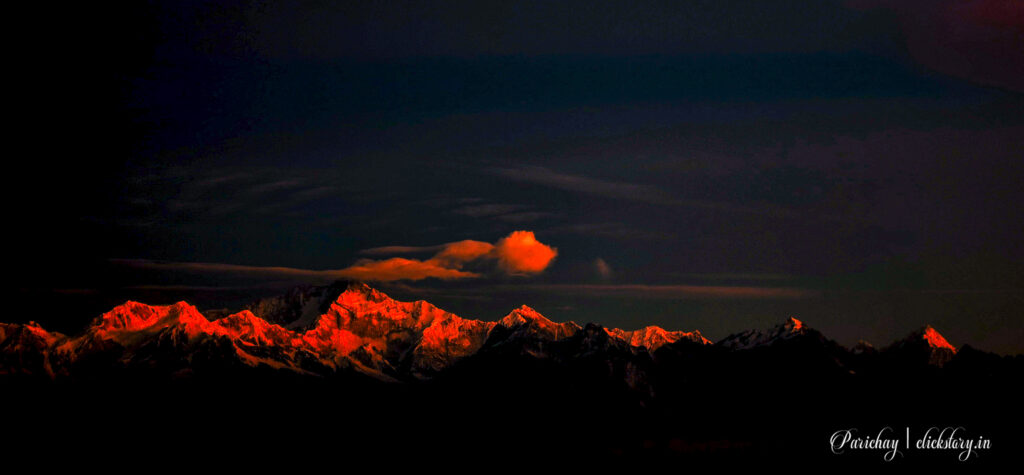
I had already checked the weather forecast, studied maps, packed extra batteries, cleaned my lenses, and even imagined the photograph before I arrived. Like many photographers, I believed preparation was everything.
When I finally reached the viewpoint, I wasn’t alone. A dozen photographers were already there.
Some had heavy tripods planted firmly into the rocky ground. Others were changing filters or discussing camera settings in hushed voices. One photographer was comparing dynamic range between two cameras. Another was checking the histogram from a test shot.
Nobody was speaking about the sunrise itself. Everyone was speaking about photographing it. Without thinking, I joined them.
- Camera.
- Wide-angle lens.
- ISO 100.
- Aperture f/11.
Everything exactly as planned.
Then nature began its performance.
The eastern sky slowly turned from deep indigo into violet.
Moments later, streaks of orange appeared like brushstrokes across the horizon.
Clouds that looked ordinary only minutes before suddenly glowed with brilliant shades of crimson and gold.
The valley below slowly emerged from darkness as layers of mist drifted gently between the hills.
It was breathtaking. Or at least, I assume it was. Because I wasn’t really watching it. I was watching through the viewfinder of my camera.
- Click.
- Check exposure.
- Click.
- Zoom in.
- Adjust composition.
- Bracket three exposures.
- Check histogram.
- Click again.
- Repeat.
By the time the sun finally cleared the horizon, I had already taken more than two hundred photographs.
I felt satisfied. Perhaps even proud.
Surely one of those images would become my best landscape photograph.
As I packed my equipment, I noticed someone sitting several metres away.
An elderly man.
No camera.
No phone.
No tripod.
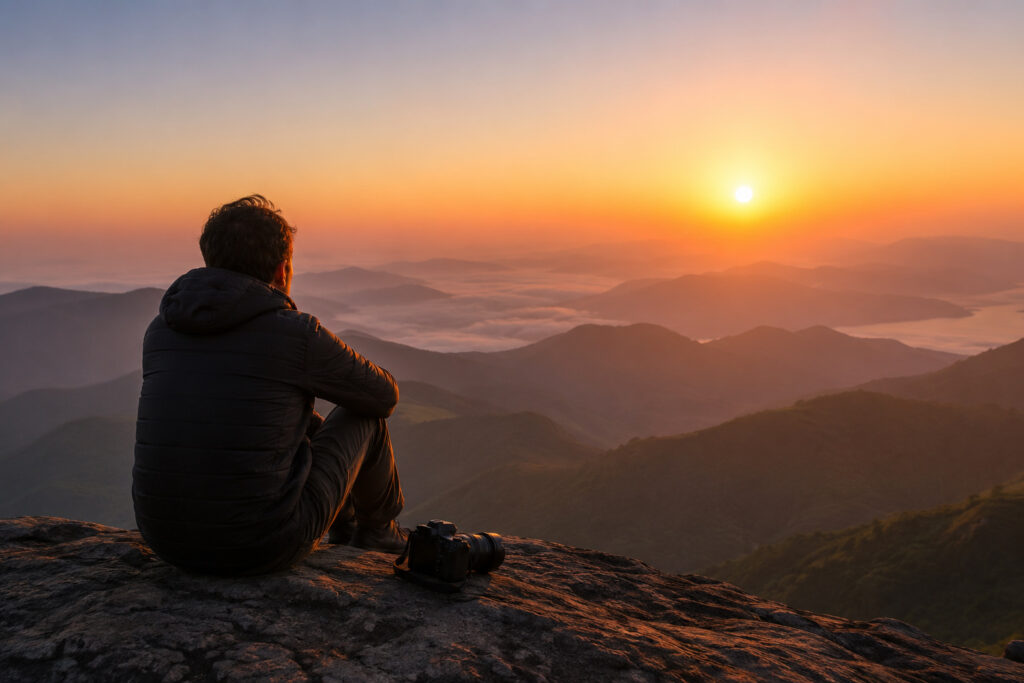
Just a worn jacket, a walking stick resting beside him, and a peaceful smile as he watched the morning unfold. For nearly half an hour he hadn’t moved.
He simply looked.
Not through glass.
Not through a screen.
With his own eyes.
As I walked back down the trail, a question quietly followed me.
Who experienced that sunrise more deeply?
The photographer carrying thousands of dollars’ worth of equipment…
or the man carrying nothing except his curiosity?
That question has stayed with me for years.
It wasn’t because I regretted taking photographs.
I regretted forgetting to witness the very thing I had travelled so far to photograph.
The Camera Changes the Way We See
Every photographer remembers the excitement of buying their first camera. Suddenly the world feels different. Ordinary streets become potential compositions. Rain on a window becomes abstract art. Morning light spilling through the kitchen becomes something worth chasing. Photography teaches us to notice details most people overlook. It teaches:
- Patience.
- Observation.
- Curiosity.
- Wonder.
Few hobbies encourage us to appreciate the world as deeply as photography does. Yet cameras possess a strange paradox. The same tool that teaches us to observe can also prevent us from experiencing what we observe.
It happens so gradually that most of us never notice.
The camera comes to our eye before the moment reaches our heart.
Instead of asking,
“How does this place make me feel?”
we ask,
“Which lens should I use?”
Instead of hearing birdsong, we listen for autofocus confirmation.
Instead of breathing in mountain air, we worry about white balance.
Instead of laughing with friends, we ask them to laugh again because the first shot wasn’t sharp enough. The camera doesn’t create this distance intentionally.
Neither do we.
It simply happens.
One photograph at a time.
Somewhere Along the Way…
- Photography wasn’t invented to replace memory. It was invented to preserve it.
- The earliest photographers weren’t obsessed with megapixels.
- They weren’t chasing social media engagement.
- They weren’t wondering whether an image would receive hundreds of likes.
- They photographed people they loved.
- Places that mattered.
- Moments history might otherwise forget.
- Every photograph carried weight because making one wasn’t easy.
- Each exposure required patience.
- Thought.
- Intention.
Today we carry cameras more powerful than professional equipment from only twenty years ago. We can take thousands of photographs without changing a roll of film.
- Delete mistakes instantly.
- Edit colours within seconds.
- Share images across the world before leaving the location.
- Technology has become extraordinary.
- But something else quietly disappeared.
- Scarcity.
- When photographs were limited, every frame mattered.
Now, because every photograph costs almost nothing, many of us treat photographs as though they mean almost nothing.
We press the shutter before asking ourselves whether the moment deserves to be remembered. Ironically, the easier photography became, the harder it became to truly see.
A Morning in Varanasi
I learned this lesson again in one of India’s oldest cities.
Before sunrise, the ghats of Varanasi were already awake.
Temple bells echoed across the Ganges.
Priests chanted ancient hymns.
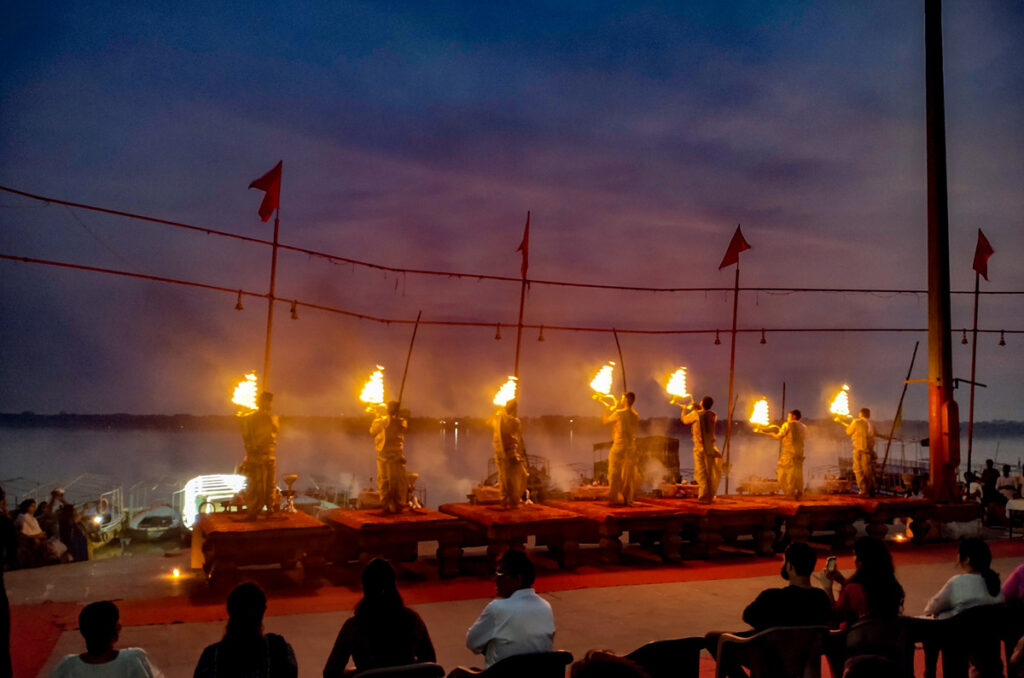
The first rays of sunlight painted the stone steps in warm shades of amber.
Boats drifted quietly across the river while smoke from incense curled gently into the cool morning air.
It was a photographer’s dream.
Naturally, cameras were everywhere.
Some photographers ran from one ghat to another chasing dramatic compositions.
Tourists lifted their phones every few seconds.
One man was so focused on photographing a sadhu that he nearly walked into the river.
Then something caught my attention.
Not through my viewfinder.
With my own eyes.
An elderly woman sat quietly at the edge of the steps, her hands folded in prayer.
She wasn’t posing.
She wasn’t performing for tourists.
She wasn’t aware that dozens of cameras surrounded her.
The rising sun illuminated only half her face while the other half remained softly hidden in shadow.
It was one of the most beautiful scenes I had witnessed that morning.
I didn’t photograph it immediately.
For nearly a minute I simply watched.
I listened to the bells.
The birds.
The gentle movement of the water.
Only then did I slowly raise my camera.
I took just three photographs.
Not thirty.
Not three hundred.
Three.
One of them remains among my favourites—not because it is technically perfect, but because I still remember exactly how that morning felt.
That photograph doesn’t just remind me of Varanasi. It reminds me that sometimes the most important part of photography happens before the shutter clicks.
We Rarely Forget the Moments We Truly Live
Think about your own life for a moment.
Close your eyes and remember your happiest day.
Perhaps it was your wedding.
The birth of your child.
A family trip.
- A conversation with someone you deeply loved.
- Maybe it was something much simpler.
- The first time you saw the sea.
- A cup of tea shared with your grandfather during a monsoon afternoon.
- Flying a kite on a rooftop as a child.
- Notice something interesting.
- You probably don’t remember those moments because of photographs.
- You remember them because you lived them.
- The photograph came later.
- The memory came first.
And perhaps that is the lesson photography has been trying to teach us all along.
A camera can preserve a memory.
It cannot create one.
Chapter Two
The People We Photograph… and the Moments We Sometimes Miss
A few months after that sunrise, I found myself sitting in a city park.
It wasn’t a famous location.
There were no dramatic mountains.
No golden temples.
No breathtaking landscapes that photographers dream about.
Just ordinary life unfolding on an ordinary afternoon.
Children chased one another across the grass.
A gardener quietly watered flowers along the walking path.
An elderly couple shared roasted peanuts on a wooden bench while pigeons wandered fearlessly around their feet.
Nothing extraordinary was happening.
And yet, almost every great photograph begins exactly like this—not with spectacular scenery, but with ordinary life observed carefully.
Across the park, a little girl was running as fast as her tiny legs would carry her.
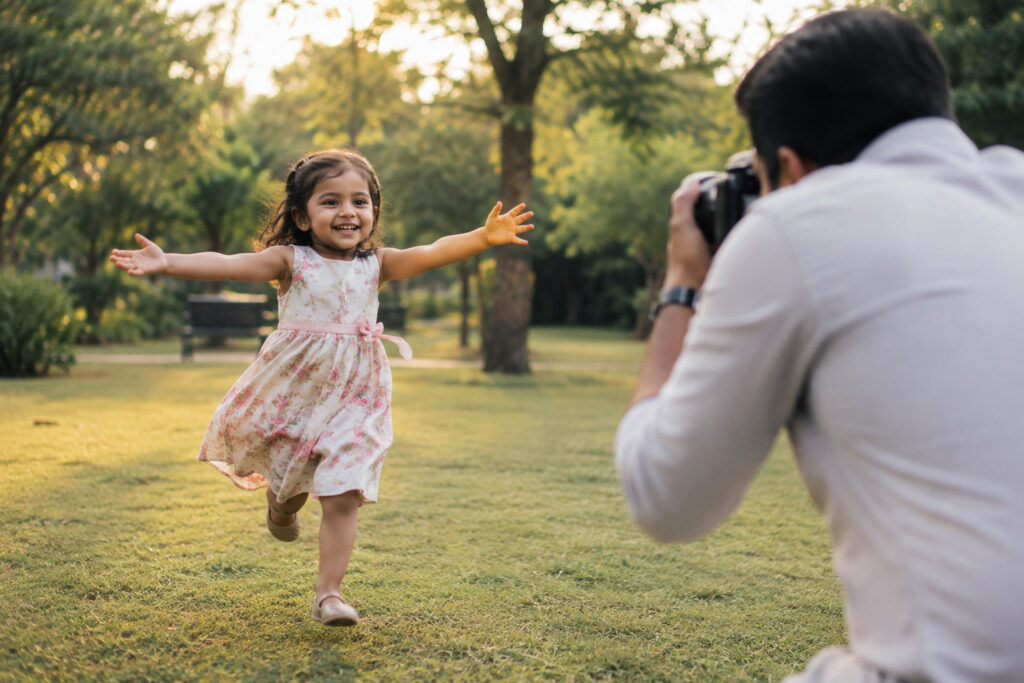
Every few seconds she turned around.
- “Daddy… look!”
- Her father smiled.
- Then instinctively raised his camera.
- Click.
- She spun in circles with both arms stretched wide.
- Click.
- She jumped from a low wall.
- Click.
- She laughed so hard that she almost fell over.
- Click.
- It was obvious he loved photography.
- His camera was expensive.
- His technique was excellent.
- He crouched to her eye level.
- He anticipated expressions.
- He knew exactly when to press the shutter.
- Every photograph would probably be beautiful.
- Yet something about the scene felt strangely incomplete.
- Every time she looked back, she wasn’t looking for another photograph.
- She was looking for her father.
- For his smile.
- For eye contact.
For that unmistakable expression children search for when they want to know,
“Did you see what I just did?”
His answer was always the same.
Another click.
The Difference Between Looking and Seeing
Photography often teaches us to look carefully.
But children teach us something even more important.
- They teach us to see. There’s a difference.
- Looking is visual.
- -> Seeing is emotional.
- Looking notices colours.
- -> Seeing notices feelings.
- Looking records.
- -> Seeing remembers.
The father undoubtedly went home with wonderful photographs.
Sharp. Well exposed. Beautifully composed.
But years later, I wondered which memory his daughter would treasure more.
The pictures he made…
or the few moments when he lowered the camera, applauded, laughed, and simply became a father instead of a photographer.
-> Photography can preserve childhood.
-> Presence creates it.
A Wedding Through Hundreds of Tiny Screens
Not long afterward, I attended a wedding.
Like most Indian weddings, it was full of colour, music, laughter, and joyful chaos.
Marigold flowers decorated every corner.
The aroma of fresh jasmine mixed with incense.
Children ran between rows of chairs while relatives greeted one another after years apart.
Then came the moment everyone had been waiting for.
The bride entered.
The music softened.
Conversation stopped.
For a brief moment, time itself seemed to slow down.
She looked toward her family.
Toward her closest friends.
Toward the people she loved most.
And what greeted her?
Not smiling faces.
Not teary eyes.
Not expressions of joy.
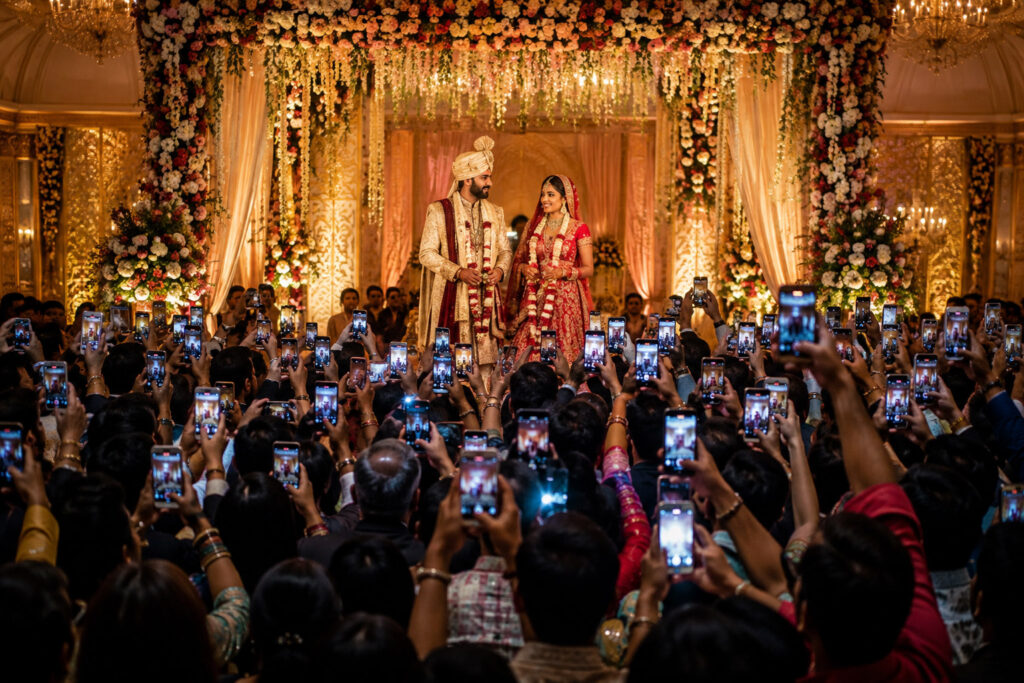
A forest of mobile phones.
Dozens of glowing rectangles floating above people’s heads.
Everyone wanted to preserve the moment.
Almost nobody was experiencing it.
I couldn’t help thinking about the bride years later.
Would she remember seeing her loved ones?
Or would she remember seeing hundreds of screens pointed toward her?
Ironically, there were already three professional photographers documenting every second of the ceremony.
Their responsibility was to create lasting memories.
The guests had a different responsibility.
To become part of those memories.
There’s a quiet beauty in clapping instead of recording.
In smiling instead of filming.
In witnessing instead of documenting.
Sometimes the greatest gift we can give another person is our undivided attention.
No camera can replace that.
The Concert Nobody Watched
The same thing happened one evening during a live music concert.
The lights dimmed.
The audience erupted into cheers.
In the climax something remarkable happened.
Almost six hundred hands rose into the air.
Not to applaud.
To record.
Within seconds, the entire venue transformed into an ocean of glowing screens.
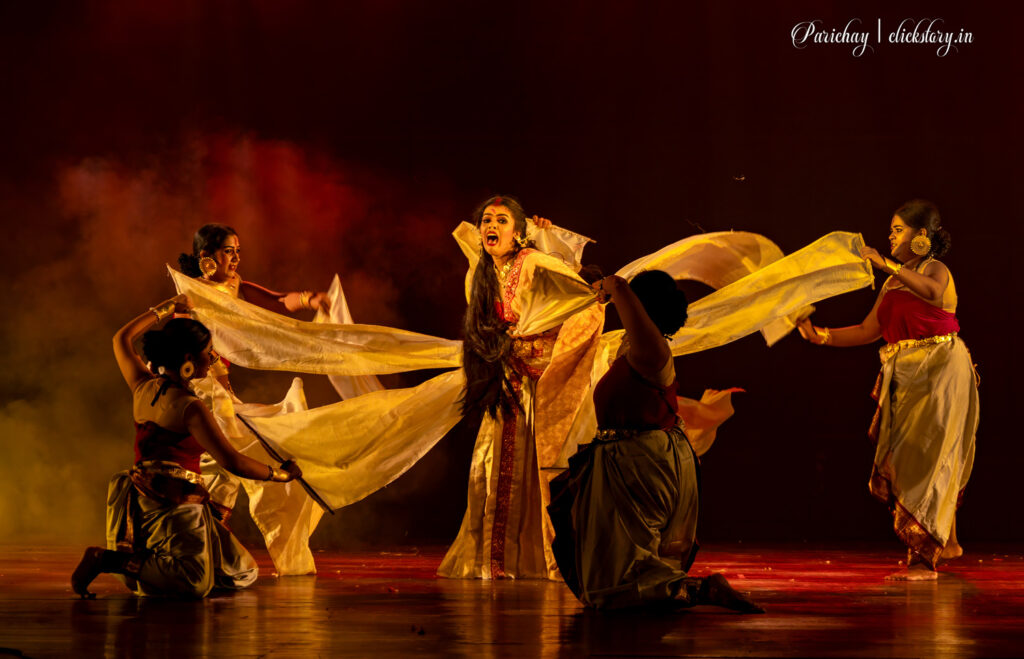
From where I stood, I could barely see the performer.
I could, however, see hundreds of tiny versions of the performer on thousands of mobile phones.
Everyone wanted proof they had been there.
Very few were actually there.
Years from now, almost nobody will sit down on a Sunday afternoon and watch that shaky dance video.
But everyone who lowered their phone, moved along, tears and anger, felt the vibes, vibrating through their chest…
they’ll remember.
Not because they recorded it.
Because they lived it.
That realization extends far beyond concerts.
It reaches into every corner of photography.
The value of a moment is never measured by how many gigabytes it occupies.
It’s measured by how deeply it touches us.
Henri Cartier-Bresson Wasn’t Chasing Photographs
He was one of the greatest photographers who ever lived, famously said,
“Your first 10,000 photographs are your worst.”
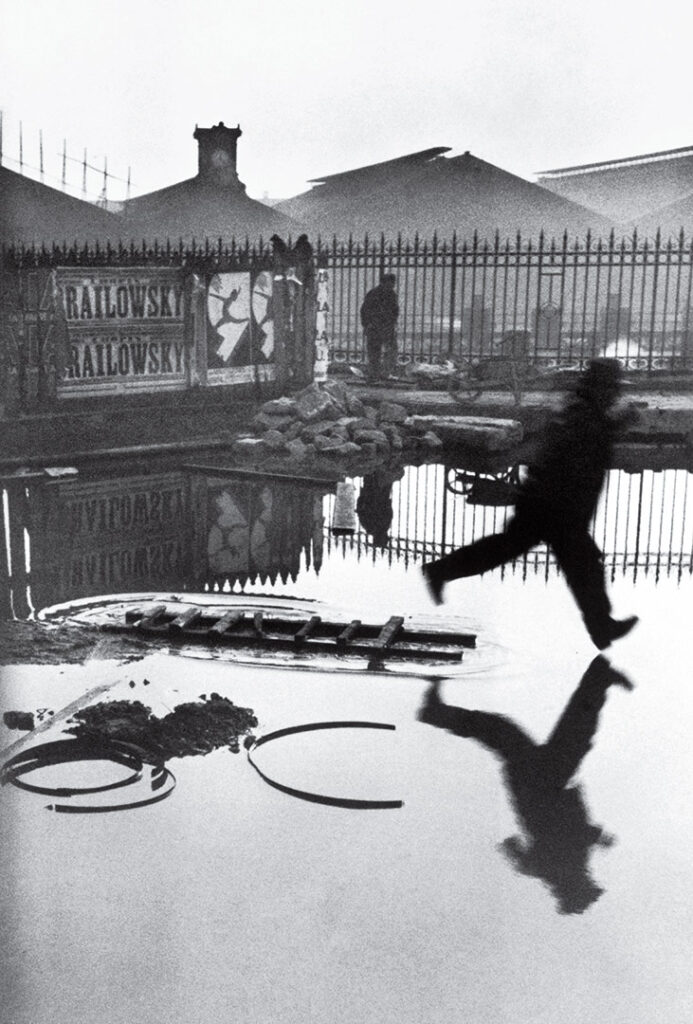
People often interpret that quote as advice to take more photographs.
I don’t think that’s what made him extraordinary.
Cartier-Bresson spent far more time observing than pressing the shutter.
He wandered streets for hours.
He watched.
He waited.
He allowed life to unfold naturally before making a photograph.
His famous idea of the “decisive moment” wasn’t about reacting quickly.
It was about preparing patiently.
The decisive moment belongs to photographers who first learn how to wait.
That lesson feels surprisingly difficult in an age where our cameras can shoot thirty frames every second.
Technology has become faster.
Human attention hasn’t.
The Family Album
One rainy afternoon, while helping my parents organize old photographs, I noticed something I had somehow overlooked for years.
There were albums from birthdays.
Family vacations.
School functions.
Durga Puja celebrations.
Picnics.
Anniversaries.
Hundreds of memories.
Then I noticed someone was missing.
My father.
He appeared occasionally.
My mother appeared often.
My sister smiled from almost every page.
I appeared in more photographs than I expected.
But my father…
the man behind the camera…
had quietly disappeared from the family’s visual history.
Whenever something important happened, he instinctively reached for the camera.
He preserved everyone else’s memories.
At the cost of appearing in very few of them himself.
When I asked him about it, he simply laughed.
“Someone had to take the picture.”
At the time, his answer sounded practical.
Years later, it sounded heartbreaking.
Photography is an act of generosity.
The photographer often gives everyone else a memory while unknowingly removing themselves from it.
Since that afternoon, I’ve made a small promise to myself.
Every trip.
Every celebration.
Every family gathering.
At least once…
I’ll hand my camera to someone else.
Not because I need another photograph.
But because one day, someone I love might want to remember that I was there too.
The Tourist Who Never Really Arrived
Travel photography has changed dramatically over the last decade.
Today, many journeys begin with a checklist.
- Sunrise at the Taj Mahal.
- Reflection shot.
- Check.
- Blue City rooftop in Jodhpur.
- Check.
- Tea gardens in Darjeeling.
- Check.
- Houseboats in Kerala.
- Check.
Some travellers move through extraordinary places with astonishing efficiency.
Arrive. Pose. Smile. Take twenty photographs. Leave.
When they return home, they possess hundreds of beautiful images.
Ask them about the smell of the morning air.
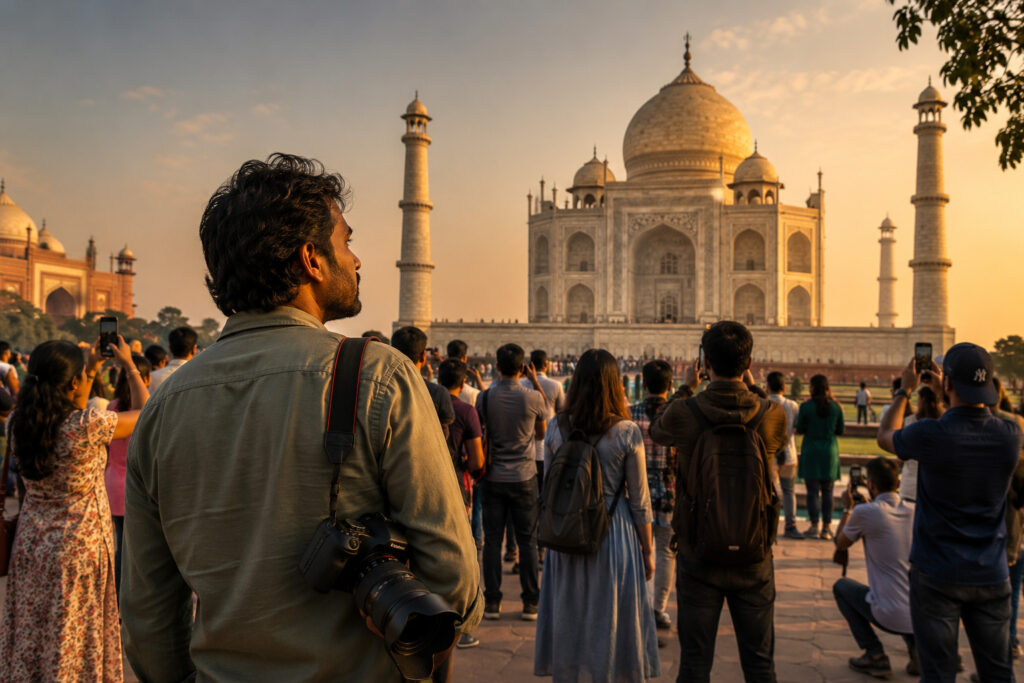
The conversations they overheard.
The old shopkeeper who insisted they taste homemade sweets.
The musician performing in a quiet alley.
The sudden rainstorm that sent strangers running beneath the same roof.
Those memories are often missing.
Not because they didn’t happen.
Because they were too busy collecting evidence that they had visited.
Travel is not a competition to gather photographs.
It’s an opportunity to gather perspective.
Sometimes the richest souvenir from a journey isn’t a photograph at all.
It’s a story you’ll tell for the rest of your life.
A Quiet Lesson from Kolkata
A few winters ago, I spent an early morning walking through Kumartuli, the historic neighborhood in Kolkata where generations of artisans create clay idols by hand.
I arrived with the same intention every photographer has—to capture something beautiful.
The lanes were still waking up.
Soft sunlight filtered through gaps in old tin roofs.
Dust floated gently in the beams of light.
The smell of wet clay filled the air.
Inside one workshop, an elderly sculptor was shaping the fingers of a Durga idol with astonishing patience.
His hands moved slowly, almost rhythmically.
I lifted my camera.
Then stopped.
For several minutes, I simply watched him work.
He never hurried.
Never looked at a clock.
Every tiny movement mattered because every tiny movement became part of something larger.
Only after watching quietly did I take a handful of photographs.
As I left Kumartuli that morning, it occurred to me that the sculptor had unknowingly taught me something about photography.
Masterpieces are rarely created in a hurry.
Neither are meaningful photographs.
What We Really Carry Home
When every journey ends, we carry two collections home.
-> One fits inside a camera bag.
-> The other lives quietly inside us.
- One collection contains photographs.
- The other contains memories.
If we’re lucky…
-> Both collections tell the same story.
But if we become too obsessed with creating the first, we sometimes neglect the second.
And no camera, no matter how advanced, can photograph a memory that was never fully lived.
Chapter Three
Learning to See Again
“Photography is the story I fail to put into words.”
— Destin Sparks
The older I become as a photographer, the less I believe that photography is about cameras.
It isn’t about sensors.
It isn’t about megapixels.
It isn’t even about light.
At its heart, photography is about attention.
Not the attention we seek from others.
The attention we give to the world.
Children understand this naturally.
Watch a child looking at a butterfly.

Notice how they don’t immediately think about recording it.
They simply watch.
Curiosity comes before documentation.
Wonder comes before ownership.
Somewhere between childhood and adulthood, many of us reverse that order.
Instead of asking,
“What is this moment trying to tell me?”
we ask,
“How can I capture this?”
It sounds like a small difference.
It isn’t.
That single question quietly changes the way we experience the world.
The Day I Didn’t Take the Photograph
Several years ago, I was walking through the tea gardens of Darjeeling just after sunrise.
The mist still clung to the hills like a soft white blanket.
Workers moved silently between endless rows of tea bushes, their woven baskets resting against their backs.
The morning was almost completely silent except for birds and the occasional distant whistle from the toy train.
As I rounded a narrow path, I saw something beautiful.
An elderly woman had stopped working.
She stood facing the mountains, warming her hands around a small cup of tea.
The rising sun illuminated the steam drifting upward while the mountains behind her slowly emerged from the mist.
Everything about the scene was perfect.
The light.
The colours.
The composition.
The emotion.
Instinctively, my hand reached for the camera.
Then I stopped.
Not because I couldn’t make the photograph.
Because I wasn’t sure I needed to.
For nearly two minutes, I simply stood there.
The woman never noticed me.
She wasn’t performing.
She wasn’t posing.
She was simply beginning another ordinary day.
Eventually, she finished her tea, smiled toward another worker, and disappeared into the rows of tea bushes.
I never pressed the shutter.
For years, I wondered whether I had made a mistake.
Today, I think it may have been one of the best photographic decisions I’ve ever made.
Because I remember that morning with extraordinary clarity.
Not because of a photograph.
Because I was completely present.
That memory has never faded.
We Photograph Because We Are Afraid
Not afraid of photography.
Afraid of forgetting.
Think about how often we say things like,
“I need to take a picture so I’ll remember this.”
It’s such a common sentence that we rarely question it.
But memory is strange.
The experiences that shape our lives usually don’t disappear simply because we failed to photograph them.
-> Can you remember your grandmother’s voice?
-> Your first day at school?
-> The smell of your childhood home after rain?
-> Your first bicycle?
-> Your favourite teacher?
Most people can.
Not because they own perfect photographs.
Because those moments mattered.
Emotion strengthens memory far more than documentation does.
The more deeply we experience something, the more likely we are to remember it.
Photography can help preserve memory. It cannot replace living.
The Invisible Audience
Social media introduced something previous generations of photographers rarely had to consider.
An audience.
Every photograph now has the possibility of being seen by hundreds…
sometimes thousands…
sometimes millions of people.
Without realizing it, many photographers quietly stopped asking,
“Do I love this photograph?”
and began asking,
“Will other people love this photograph?”
Those questions often lead in very different directions.
One creates personal work.
The other creates performance.
Of course, there is nothing wrong with sharing photographs.
Photography has always been about communication.
But communication becomes unhealthy when we begin experiencing life primarily through the expectations of strangers.
A sunset doesn’t become more beautiful because it receives ten thousand likes.
Nor does it become less beautiful because nobody photographs it at all.
Nature has never needed our approval.
Perhaps we don’t need everyone else’s quite as much as we think.
The Camera Doesn’t Know What Matters
Modern cameras are extraordinary.
They recognize faces.
Track eyes.
Predict movement.
Focus in near darkness.
Correct exposure automatically.
Artificial intelligence can even remove distractions, sharpen blurry images, and generate details that never existed.
Yet there remains one thing no technology has learned.
Meaning.
A camera cannot recognize grief.
Or hope.
Or relief.
Or nostalgia.
Imagine photographing two people sitting quietly on a railway platform.
To a camera, they are simply two people.
To you, they may be lifelong friends saying goodbye.
Or a father seeing his daughter leave for university.
Or a couple meeting after years apart.
The camera records appearance.
The photographer discovers significance.
That is why two photographers standing beside one another can create completely different images.
Not because their cameras differ.
Because their hearts notice different stories.
The Wisdom of Waiting
Henri Cartier-Bresson often spoke about the decisive moment.
Many photographers interpret that phrase as speed.
As though great photographers possess superhuman reflexes.
I believe the opposite is closer to the truth.
The decisive moment belongs to photographers who first learn how to wait.
Street photographers understand this instinctively.
Sometimes they remain on the same corner for an hour.
Watching.
Listening.
Learning the rhythm of the street.
Children walking to school.
Shopkeepers arranging fruit.
Cyclists weaving through traffic.
Dogs sleeping beneath tea stalls.
Nothing seems extraordinary.
Until suddenly…
everything aligns.
A ray of sunlight.
A human expression.
A gesture.
A shadow.
Click.
One photograph.
Then they lower the camera again.
Waiting isn’t wasted time.
Waiting is where photography begins.
The Slow Photographer
There is an idea in Japanese culture called “ma.”
It has no perfect English translation.
Broadly, it refers to the meaningful space between things—the pause that gives rhythm and significance.
Music depends on silence between notes.
Conversations depend on pauses between words.
Architecture depends on empty space as much as walls.
Photography is no different.
Perhaps our photographs also need a little ma.
A pause before the shutter.
A breath before the composition.
A quiet moment before deciding whether the photograph needs to exist at all.
When we rush, we often photograph what is obvious.
When we pause, we begin noticing what is meaningful.
A Lesson From an Old Street Photographer
Many years ago, while walking through the narrow lanes of North Kolkata, I met an elderly street photographer.
His camera looked older than many of the people passing by.
We spoke for a few minutes.
Curious, I asked him how he always seemed to know exactly when to take a picture.
He smiled.
Then he said something I have never forgotten.
“Most young photographers are always looking for photographs.”
He paused.
“I wait for life.”
That was all.
No technical explanation.
No discussion about lenses.
No mention of camera settings.
Just four simple words.
I wait for life.
The older I become, the wiser those words seem.
Seeing Without the Viewfinder
Try a simple experiment.
The next time you visit a beautiful place, don’t take your camera out immediately.
Instead…
Sit down.
Stay completely still for five minutes.
Watch how people move through the space.
Notice where the light changes.
Listen carefully.
You might hear temple bells echoing through a city.
Leaves brushing against one another in the wind.
Children laughing somewhere behind you.
A train in the distance.
Footsteps.
Birdsong.
The quiet hum of life continuing without any awareness of your presence.
Then close your eyes for just a moment.
When you open them again, ask yourself,
What is the story here?
Not…
What is the photograph?
The story always comes first.
The photograph merely follows.
Dorothea Lange Understood This
Dorothea Lange once wrote,
“The camera is an instrument that teaches people how to see without a camera.”
People often quote that sentence because it sounds beautiful.
I think it is much more than beautiful.
It is a challenge.
If years of photography haven’t made us more observant…
more patient…
more compassionate…
more curious…
then perhaps we have learned to operate cameras without truly learning photography.
A camera should eventually become almost invisible.
Not physically.
Mentally.
It should become an extension of your attention rather than the centre of it.
The best photographers I’ve ever met rarely talk about equipment for very long.
Instead, they talk about people.
- Weather.
- Light.
- Stories.
- Travel.
- Music.
- Books.
- Life.
Because life always comes before photography.
Photography simply follows wherever life leads.
When the Camera Finally Becomes Light
There comes a point in every photographer’s journey when the weight of the camera begins to disappear.
Not because it becomes physically lighter.
Because it no longer interrupts your experience.
You stop thinking constantly about settings.
Your hands know what to do.
Your eyes become free again.
And once your eyes are free…
your heart quietly returns to the conversation.
That, I believe, is when photography truly begins.
Not on the day you buy your first camera.
Not on the day you master manual mode.
But on the day you realize the camera is no longer the most important thing you brought with you.
Your attention is.
Chapter Four
The Best Photograph You’ll Never Take
Photography has always lived between two beautiful desires.
The desire to remember…
and the desire to experience.
Most of the time, these two work together.
A photograph helps us revisit a place long after we’ve left it.
It reminds us of a smile that has faded with time.
It preserves faces that eventually become memories.
Photography has given humanity an extraordinary gift.
For the first time in history, ordinary people could preserve ordinary lives.
Not kings.
Not famous artists.
Not world leaders.
Everyone.
A farmer holding his newborn child.
A grandmother laughing during a family gathering.
Children playing cricket in an empty field.
Friends sharing tea on a rainy afternoon.
A couple walking hand in hand after fifty years of marriage.
These moments may never appear in history books.
Yet they are history.
They are our history.
That is why photography matters.
Not because cameras are remarkable.
Because people are.
Some Moments Must Be Photographed
After reading this article, you might think I’m suggesting photographers should leave their cameras at home.
Nothing could be further from the truth.
There are moments that deserve to be preserved.
Your child’s first steps.
Your parents growing older.
Your sister’s wedding.
A rare bird you’ve spent months hoping to see.
The first snowfall you’ve ever witnessed.
The final portrait of someone you deeply love.
Life moves only in one direction.
Some moments truly never return.
Raise your camera.
Press the shutter.
Preserve them.
But do so with intention rather than impulse.
Take the photograph.
Then lower the camera.
Stay.
Listen.
Smile.
Become part of the memory instead of only its recorder.
A single thoughtful photograph often tells a richer story than a hundred hurried ones.
Ask One Question Before Every Photograph
Over the years, I’ve realized that photography doesn’t need more rules.
It needs better questions.
Before lifting your camera, pause for just a second and ask yourself:
“Why am I making this photograph?”
There are no wrong answers.
Perhaps because the light is extraordinary.
Perhaps because your daughter will never be six years old again.
Perhaps because the expression on a stranger’s face tells a story that words cannot.
Perhaps because twenty years from now, you’ll want to remember exactly how this place made you feel.
When you know your reason, your photographs become more than records.
They become reflections.
The One-Minute Rule
If I could leave every photographer with only one practical habit, it would be this.
Whenever you arrive somewhere beautiful…
wait.
Just one minute.
Don’t touch your camera.
Don’t check your phone.
Don’t think about settings.
Simply arrive.
Listen to the wind.
Watch the changing light.
Notice where shadows fall.
Observe how people naturally move through the scene.
You’ll begin seeing details that hurried photographers miss.
The old man feeding birds before sunrise.
A child reaching for her mother’s hand.
Rain collecting on the edge of a leaf.
The brief smile exchanged between two strangers.
The tiny stories that quietly transform ordinary photographs into unforgettable ones.
Photography begins long before the shutter clicks.
It begins with attention.
The Photographer Missing From Every Frame
One day, perhaps many years from now, someone you love will open an old box filled with your photographs.
Maybe your children.
Maybe your grandchildren.
Maybe someone who never had the chance to meet you.
They’ll gently turn each page.
They’ll see birthdays.
Vacations.
Festivals.
Long-forgotten cars parked beside familiar houses.
Friends whose hair has turned grey.
Pets who are no longer waiting at the front door.
People who laughed loudly.
People who cried quietly.
People who mattered.
The photographs will tell stories.
But then they may notice something.
You are missing.
Not from one photograph.
From many of them.
Because you were always behind the camera.
Don’t let your love for photography quietly erase your presence from your own family’s history.
Step into the frame.
Hand the camera to someone else.
Use a tripod.
Ask a passerby.
Someday, that photograph may mean far more than the perfect landscape you spent an hour composing.
Cameras Will Continue to Change
Over the next decade, cameras will become even more intelligent.
Artificial intelligence will focus faster.
Recognize scenes more accurately.
Remove distractions automatically.
Generate perfect exposures.
Perhaps one day cameras will even suggest compositions before we notice them ourselves.
Technology will continue moving forward.
It always does.
But there is one thing no machine will ever replace.
The ability to feel something.
A camera can measure light.
Only you can recognize love.
A camera can detect faces.
Only you understand relationships.
A camera records appearances.
You discover meaning.
That is why photography remains deeply human, no matter how advanced technology becomes.
Looking Without Needing to Own
One of the greatest lessons photography teaches has nothing to do with photographs.
It teaches us to notice.
The way evening light enters an old window.
The quiet rhythm of rain on a tin roof.
The wrinkles on a grandfather’s hands.
The joy hidden inside a child’s laughter.
The patience of a street vendor waiting for customers.
The silence between temple bells at dawn.
Eventually you begin noticing beauty even when your camera isn’t with you.
That may be photography’s greatest gift.
Not creating photographs.
Creating observers.
The Day You Forget the Camera
There may come a day when you leave home and accidentally forget your camera.
Years ago, that might have felt like a disaster.
Now…
perhaps it becomes a gift.
Without a viewfinder between you and the world, you begin seeing differently.
You walk more slowly.
You notice details without wondering whether they are photogenic.
You admire light without trying to possess it.
You watch children play without calculating shutter speed.
You simply exist.
Ironically, those camera-less days often remind us why we fell in love with photography in the first place.
Because photography was never really about cameras.
It was about learning how to see.
A Letter to Every Photographer
If you’ve read this far, then you already understand something important.
Photography isn’t simply your hobby.
It is how you pay attention to the world.
So here’s something I’d like to leave with you.
The next time you stand before a magnificent mountain…
or a quiet village road…
or a busy street…
or a child laughing in the rain…
don’t rush.
Take one slow breath.
Look carefully.
Listen completely.
Allow yourself to belong to that moment before asking it to belong to you.
Then, if your heart still says,
“This deserves to be remembered.”
Raise your camera.
Make the photograph.
And lower it again.
Because your greatest responsibility isn’t to collect thousands of images.
It is to live a life worth remembering.
The Best Photograph You’ll Never Take
Perhaps the finest photograph of your life will never appear in Lightroom.
It will never be printed.
Never be framed.
Never be posted online.
No one will press the Like button.
No one will comment beneath it.
No photography competition will ever judge it.
Because it exists only here.
Inside you.
The sound of your daughter laughing while you forgot to reach for your camera.
The warmth of your father’s hand resting on your shoulder during a quiet evening walk.
The smell of the first rain after a long summer.
The silence before sunrise in the mountains.
The tear you quietly wiped away before anyone else noticed.
The smile exchanged with a stranger you’ll never meet again.
These moments ask for only one thing.
Your presence.
Not your camera.
And perhaps…
that is the greatest lesson photography can ever teach us.
Not every beautiful moment needs to become a photograph.
Some moments become more beautiful because they remain simply lived.
Epilogue
When people ask what camera they should buy, they often expect the answer to be a particular brand or model.
Sometimes the better answer is another question.
Have you learned to see?
Because once you truly learn to see…
almost any camera becomes enough.
And once you truly learn to be present…
every photograph begins long before the shutter clicks.
Photography is not the art of collecting images.
It is the art of collecting attention.
And attention…
is one of the purest forms of love we can offer the world.
Frequently Asked Questions (FAQ)
Is it okay not to photograph every special moment?
Absolutely. Some moments become more meaningful when they’re experienced without the distraction of a camera. A single intentional photograph often preserves a memory better than hundreds of rushed images.
Does taking fewer photos make you a better photographer?
Often, yes. Taking fewer photographs encourages patience, careful observation, and thoughtful composition, which usually leads to stronger and more meaningful images.
Why do photographers sometimes miss the moment they’re trying to capture?
Because they become focused on camera settings, composition, or recording everything instead of fully engaging with what’s happening around them. Balancing observation with photography creates a richer experience.
How can I become more mindful while taking photographs?
Pause before shooting. Spend a minute observing the light, the sounds, the people, and the atmosphere. Ask yourself what story or emotion you’re trying to capture before pressing the shutter.
Is photography about technical perfection?
Technical skills are important, but they are only tools. Memorable photographs are created through emotion, timing, storytelling, and genuine observation—not just perfect exposure or sharpness.

overwhelming article. A pice of philosophy.