

Master the Fundamentals of Portrait Photography
No matter whether you’re photographing a man, a woman, or a couple, great portraits rely on the same three fundamentals—camera angles, composition, and lighting. Even the most natural pose can lose its impact if it’s captured from an unflattering angle, framed poorly, or lit incorrectly.
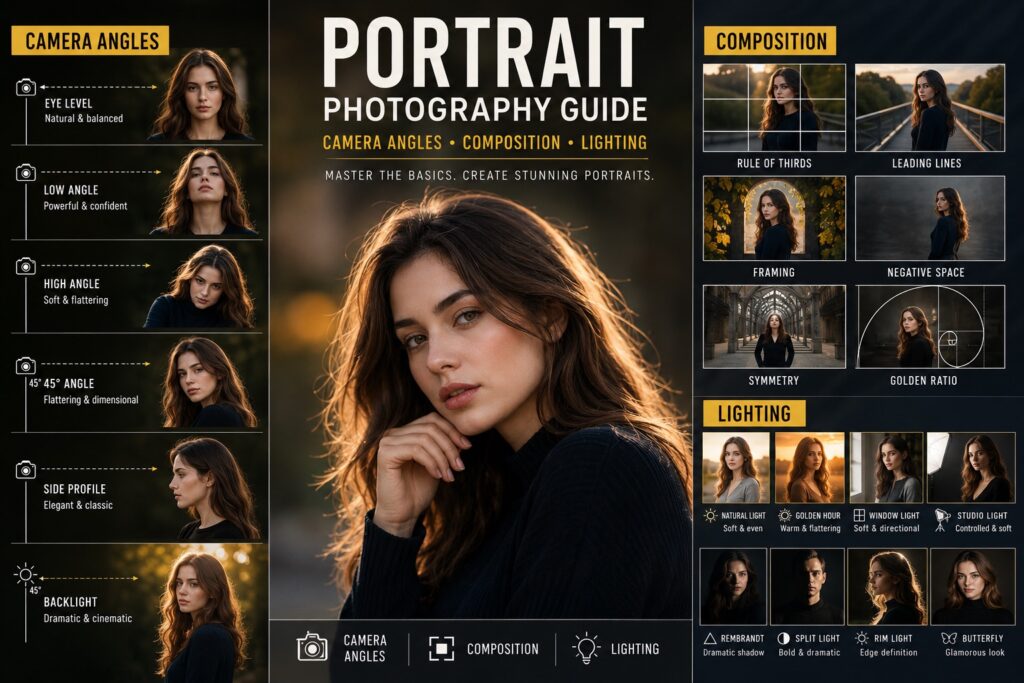
Before exploring the portrait poses below, take a few minutes to understand these essential photography techniques. They’ll help you create more professional, flattering, and emotionally engaging portraits in every photoshoot.
Camera Angles That Transform Portraits
Choosing the right camera angle is one of the easiest ways to change the mood and impact of a portrait. A simple adjustment in camera height or shooting position can make your subject appear more confident, approachable, dramatic, or artistic.
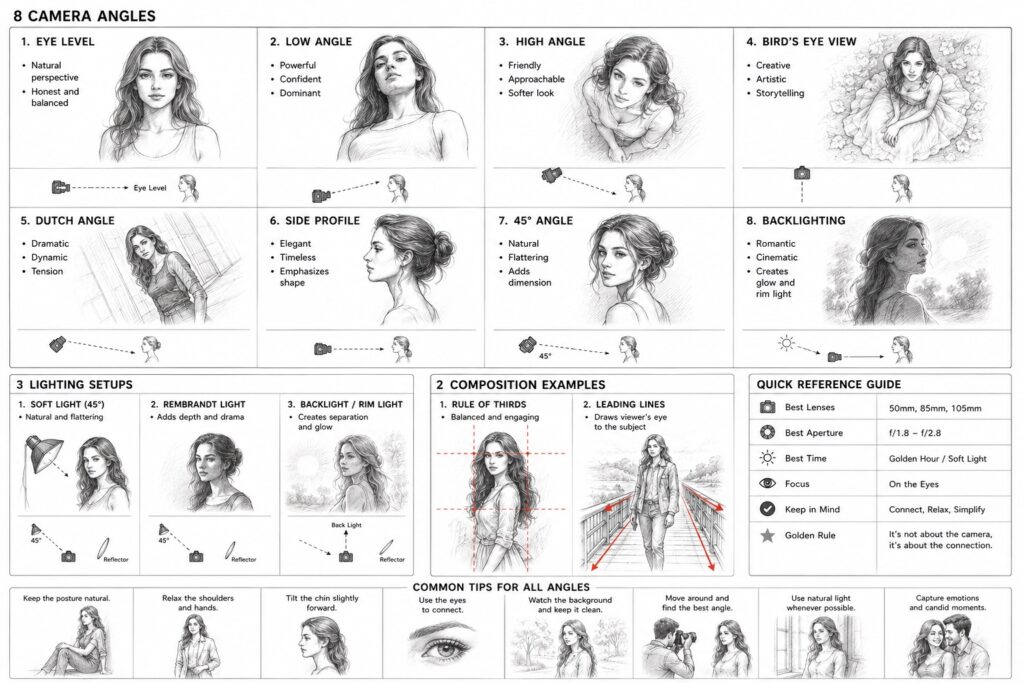
Some of the most effective portrait camera angles include:
- Eye-Level for balanced and natural portraits
- Low Angle for strength and confidence
- High Angle for a softer appearance
- Bird’s Eye View for creative storytelling
- Dutch Angle for dramatic compositions
- Side Profile to highlight facial features
- 45° Angle for flattering portraits
- Backlighting for cinematic images
Instead of shooting every portrait from eye level, experiment with multiple angles to add variety and visual interest to your portfolio.
Composition Techniques for Better Portrait Photography
Composition determines how viewers experience your photographs. Good composition naturally guides the eye to the subject while creating balance, depth, and storytelling.
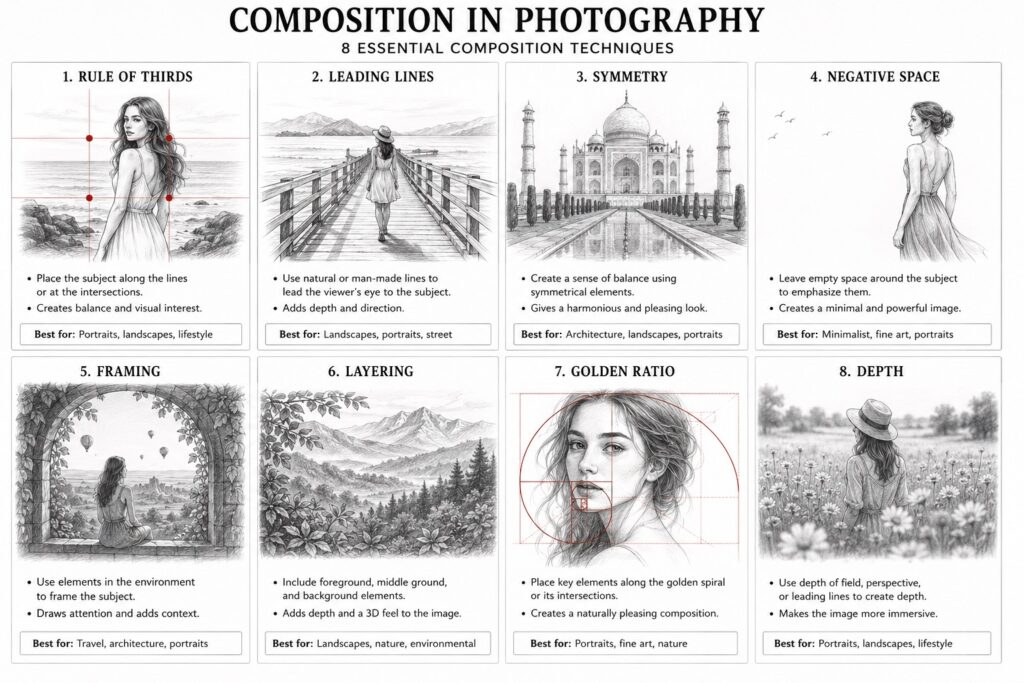
The following composition techniques work equally well for male portraits, female portraits, and couple photography:
- Rule of Thirds
- Leading Lines
- Symmetry
- Negative Space
- Natural Framing
- Layering
- Golden Ratio
- Depth
Combining strong composition with natural posing helps transform ordinary portraits into memorable images.
Portrait Lighting Essentials
Lighting shapes every portrait. It affects skin tones, facial features, mood, and the overall quality of the image. Learning a few classic lighting setups can dramatically improve your portrait photography, whether you’re shooting outdoors, indoors, or in a studio.
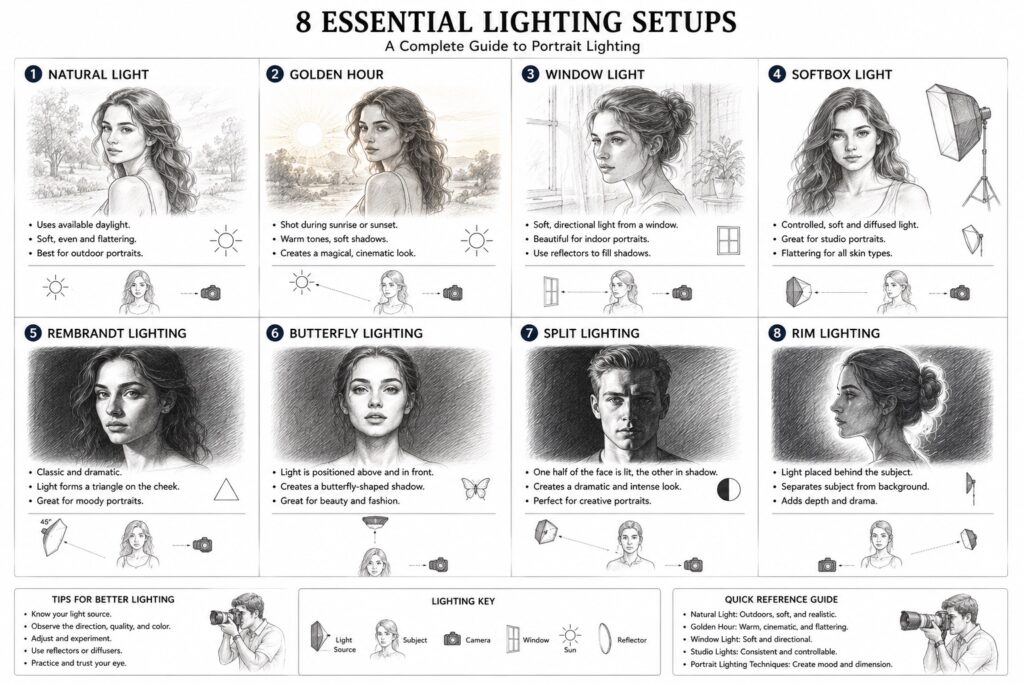
Some of the most commonly used portrait lighting techniques include:
- Natural Light
- Golden Hour Light
- Window Light
- Softbox Lighting
- Rembrandt Lighting
- Butterfly Lighting
- Split Lighting
- Rim Lighting
Practice these lighting techniques to discover which styles best complement different faces, locations, and moods.
Quick Portrait Photography Tips
Keep these simple tips in mind during every portrait session:
- Focus on your subject’s eyes for sharp, expressive images.
- Encourage relaxed, natural body language instead of stiff poses.
- Use clean backgrounds that don’t distract from the subject.
- Capture a mix of posed and candid moments.
- Shoot from different angles and distances for greater variety.
- Use soft natural light whenever possible.
- Pay attention to hand placement and posture.
- Build a connection with your subject to capture genuine expressions.
Why These Fundamentals Matter
Great portrait photography isn’t just about asking someone to strike a pose. The most compelling images are created when posing, composition, camera angles, and lighting work together. Whether you’re photographing an individual or a couple, mastering these fundamentals will help you create portraits that feel natural, expressive, and timeless.
Use the following pose ideas as inspiration, and combine them with the techniques above to elevate every portrait session.
You may be interested to know more about Male Portrait Posing Guide as well as Female Portrait Posing Guide and Couple Portrait Posing Guide.
It is essential to know more about Camera Angles, Compositions and Lighting Techniques. ->
Final touch: Professional Portrait Photography Workflow: Directing Models, Posing and Final Retouch ->
Bonus for you only.
A must read article “Exposure to Expression.”
