

What Is Visual Storytelling in Photography?
Visual storytelling is the process of using imagery to convey a narrative, an emotion, or an idea without relying strictly on text.
In photography, visual storytelling does not mean staging an elaborate movie scene or adding excessive post-processing filters to create drama. It simply means making intentional visual choices that allow the viewer to answer three basic questions:
- Who is involved?
- Where and when is this taking place?
- What is the emotional core or conflict of this moment?
Consider a single photo of an old, worn leather shoe. A standard product shot shows its texture and color. A visual storytelling photograph shows that shoe resting beside a muddy doorway next to a fresh pair of child’s sneakers—immediately raising questions about family, hard work, and generations.
Why Does Visual Storytelling Matter?
In modern visual culture, billions of sharp, high-resolution photos are uploaded online every single day. Technical perfection has become baseline.
A photograph can have flawless exposure, zero noise, and beautiful colors, yet still leave the viewer feeling disconnected. Storytelling bridges the gap between seeing an image and feeling it.
Visual Aesthetics –> “This photo looks pretty.”
Visual Storytelling –> “This photo matters to me.”
When you focus on story over pure aesthetics:
- Viewer attention spans expand: Instead of scrolling past in half a second, viewers stop to decipher details.
- Context creates meaning: A portrait becomes an environmental narrative rather than just a face.
- Sequences gain impact: Individual photographs begin to talk to each other, creating a larger cumulative emotion than a standalone shot ever could.
The 7 Essential Elements of Visual Storytelling
To turn isolated photos into a narrative, you must master seven core visual elements.
1. Subject & Character
Every story needs a protagonist. In photography, your subject is your anchor. This can be a person, an object, an animal, or even a geometric shadow. The key is to make the subject distinct so the viewer knows immediately where the narrative begins.

- Example: A single yellow rubber duck sitting in an empty white bathtub.
- Why it works: Your eye immediately goes to the duck because it stands out clearly against the plain background.
2. Context & Environment
A subject isolated against a completely blurred background loses its relationship to the world. Context provides geography, culture, time period, and social setting. The background elements should actively support who the subject is and what they are doing.
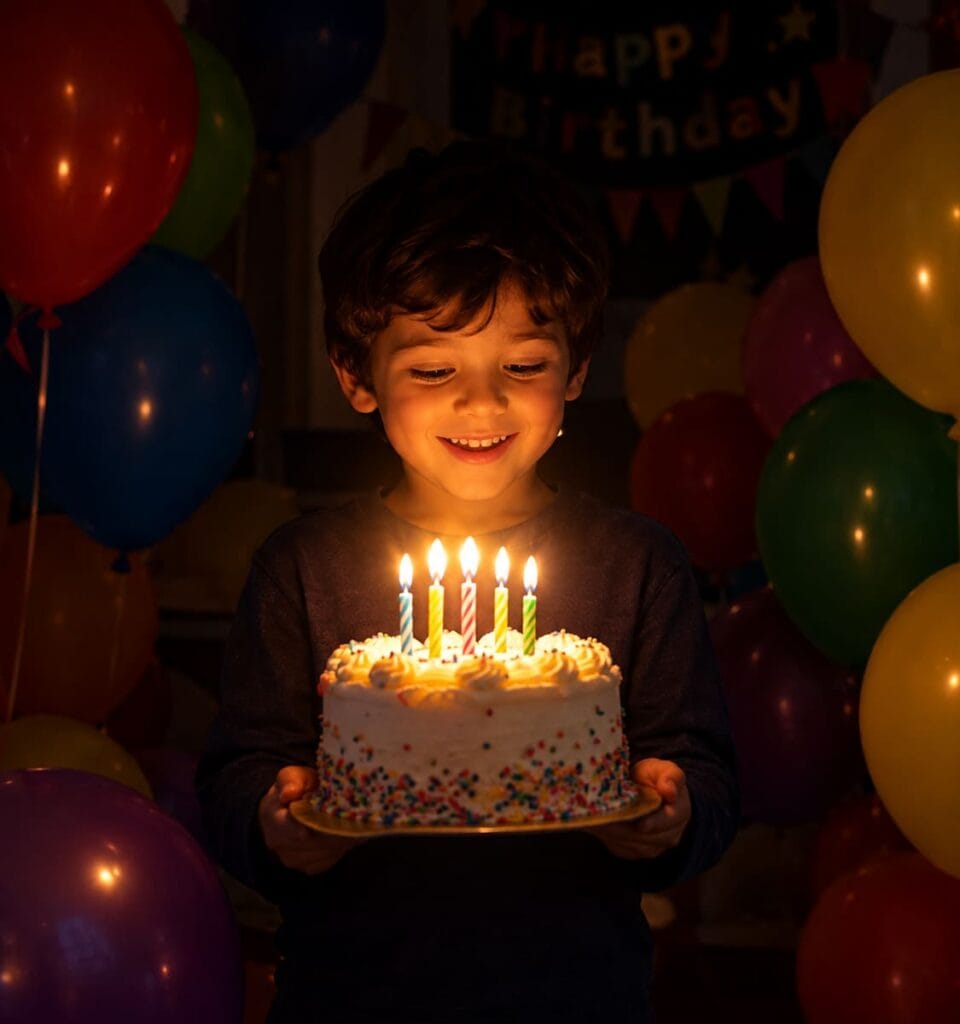
- Example: A child holding a glowing birthday cake in a dark room filled with party balloons.
- Why it works: The balloons and cake instantly tell you it is a birthday party.
3. The Decisive Moment
Narrative requires timing. A second before or after the key action can completely drain an image of its energy. The decisive moment captures peak emotion, action, or physical gesture—the peak point where the narrative hits maximum clarity.
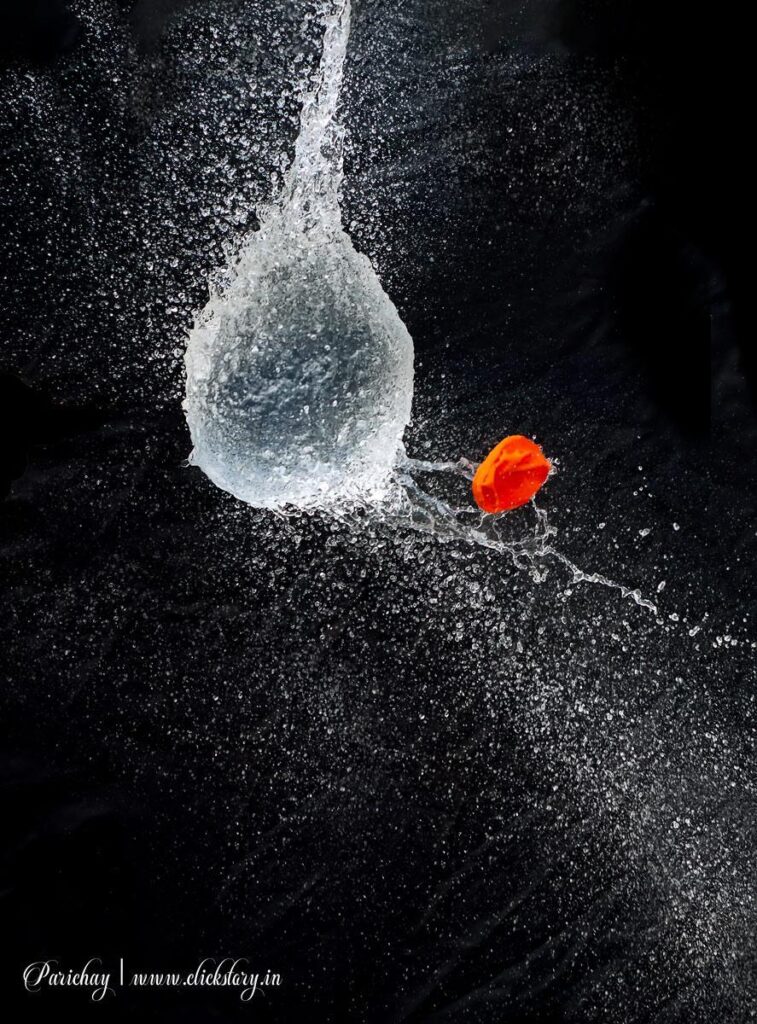
- Example: A picture of a glass of water at the exact millisecond a drop hits the surface and splashes upward into a crown shape.
- Why it works: It freezes a split-second action that is normally too fast for the human eye to catch.
4. Conflict, Tension, or Contrast
Stories require contrast to engage the mind. In visual storytelling, conflict does not necessarily mean violence or argument. It can mean light versus shadow, old versus new, stillness versus motion, or a subject looking out of place in their environment.
- Example: A tiny green plant sprouting up through a crack in a hard concrete sidewalk.
- Why it works: It contrasts soft nature with hard, man-made concrete.
5. Light & Atmosphere
Light is not merely an exposure tool; it is an emotional tone-setter. Harsh midday sunlight conveys exposure, fatigue, or cold reality. Soft golden hour light suggests nostalgia or warmth. Deep shadows introduce mystery and secrecy.

- Example: A cup of hot coffee sitting on a desk with bright, warm sunlight streaming across it.
- Why it works: The warm light makes the photo feel cozy and relaxing.
6. Perspective & Viewpoint
Where you place your camera determines how the viewer feels about the subject. Looking down on a subject makes them appear vulnerable; looking up grants them authority and power. Eye-level shooting establishes empathy and equality.
- Example: Taking a photo of a cat by getting down on the floor so the camera is at the cat’s eye level.
- Why it works: Instead of looking down at the cat like a giant, you see the world from the cat’s point of view.
7. Sequence & Rhythm (The Photo Essay)
Single images are powerful, but a collection of images builds a complex narrative. Sequence is how multiple images interact—balancing wide establishing shots with medium actions, detailed close-ups, and quiet transitions.

- Example: Making a morning cup of chai (tea):
- Wide Shot: A small gas stove on a kitchen counter with milk, loose tea leaves, and ginger laid out.
- Medium Shot: A close-up of steam rising as the tea bubbles and turns a rich brown in a small steel saucepan.
- Detail Shot: A hand pouring the hot tea through a small strainer into a traditional clay kulhar (cup).
- Why it works: By moving from the ingredients (setting the scene) to the brewing process (the action) and finally to the finished cup (the detail), the three photos flow together naturally to tell the familiar, comforting story of starting the morning in India.
Note: For your ready reference I must tell you about the shots discussed in point no. 7
The Main Three (From Point 7)
- Wide Shot (Establishing Shot)
- What it is: Shows the subject from a distance to capture the entire environment and context.
- Example: A wide shot of a bustling street corner in Kolkata with auto-rickshaws, pedestrians, and street vendors.
- Purpose: Answers the question: “Where are we?”
- Medium Shot
- What it is: Crops the subject from the waist or knees up. It balances the person and their immediate surroundings.
- Example: A vendor standing behind their cart, actively scooping out street food for a customer.
- Purpose: Focuses on the action and interaction without losing total sight of the setting.
- Detail Shot (Close-Up / Extreme Close-Up)
- What it is: A very tight shot focusing closely on a specific object, texture, or body part.
- Example: A tight shot of colorful glass bangles clinking on a person’s wrist or spices being ground on a stone.
- Purpose: Draws the viewer’s eye to emotional or textural details that add intimacy to the story.
Other Common Camera Shots
- Full Shot
- What it is: Captures a person from head to toe, fitting them entirely inside the frame while still showing a bit of the background.
- Example: A dancer in full traditional Bharatanatyam costume standing on a stage.
- Over-the-Shoulder (OTS) Shot
- What it is: Shot from behind the shoulder of one person, looking toward the person they are interacting with.
- Example: Looking over a grandmother’s shoulder as she teaches her grandchild how to draw a rangoli pattern on the floor.
- Point-of-View (POV) Shot
- What it is: Mimics what the character is actually seeing with their own eyes.
- Example: Looking straight down at a steaming plate of idlis and coconut chutney as if you are the one about to eat them.
How to Apply These Elements When Shooting
When you enter a location to shoot, follow this structured narrative workflow:
- Step 1: Observe first, shoot second (Spend 5 minutes without touching the camera).
- Step 2: Identify the core narrative thread or emotion of the space.
- Step 3: Capture an Establishing Shot (Wide view showing environment and context).
- Step 4: Move in for the Medium Action (Subject interacting with their environment).
- Step 5: Lock in on Details & Gestures (Close-ups of hands, tools, or subtle expressions).
- Step 6: Wait patiently for the Decisive Moment (The gesture that ties it together).
- Step 7: Review your shooting sequence to ensure no visual redundancy.
Camera Settings and Technical Considerations
Your technical choices directly alter narrative interpretation. Always use your camera settings to serve the story:
- Aperture & Depth of Field: While an aperture of f/1.8 isolates subjects, dropping to f/5.6 or f/8 often strengthens visual stories by keeping crucial environmental clues readable in the background.
- Shutter Speed: A fast shutter speed (1/1000s) freezes a chaotic action to show a single split-second expression. A slow shutter speed (1/15s) introduces motion blur, telling a story of speed, time passage, or chaotic energy.
- Focal Length: Telephoto lenses (85mm+ or 200mm) compress scenes and detach you from the scene. Wide-angle lenses (24mm to 35mm) force you to stand physically closer to your subjects, creating an intimate, “in-the-room” perspective for the viewer.
Building a Photo Essay: Sequence Structure
When creating a multi-image project or social media carousel, treat your work like a film edit. Use this foundational photo essay structure:
2. PORTRAIT –> Subject introduction (Who are we following?)
3. ACTION –> Main activity/interaction (What is happening?)
4. DETAIL –> Close-up on hands/objects (What subtle elements matter?)
5. CLOSING –> Quiet, resolving moment (Where does the narrative land?)
Real-World Visual Storytelling Examples
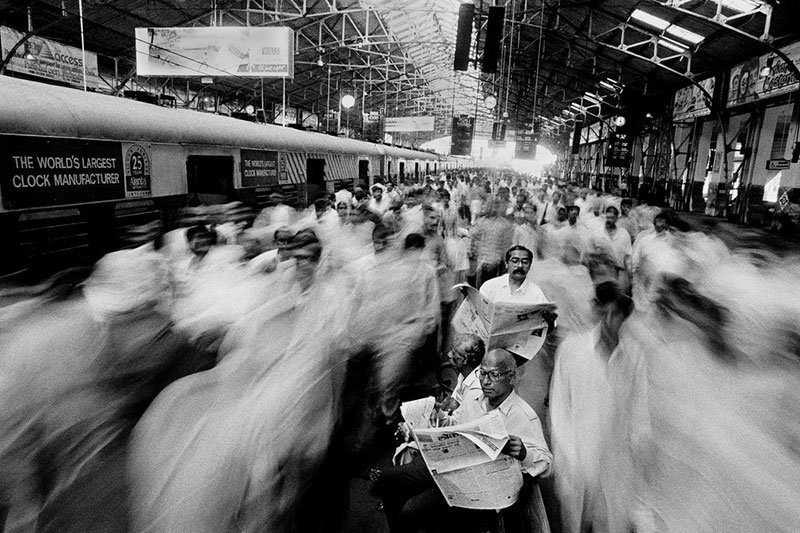
Example 1: Street Photography — The Morning Commute
- Situation: A crowded subway station during peak rush hour.
- Intention: Show the deep personal isolation felt within dense urban crowds.
- What to Photograph: Frame a single commuter1 standing completely still while dozens of blurred commuters rush past them (using a 1/8s shutter speed).
- Why It Works: The physical contrast between motion blur and sharp stillness visually communicates psychological detachment.
Example 2: Indian Cultural Photography — Festival Preparations
- Situation: Artisans crafting clay idols before a major cultural festival in Kolkata.
- Intention: Capture the dedication and physical toll2 behind sacred craftsmanship.
- What to Photograph: A tight detail shot of an artisan’s mud-stained hands meticulously carving the fine features of an idol’s eyes.
- Why It Works: It shifts the focus from the grand public celebration to the intimate human effort that makes the festival possible.
Example 3: Environmental Portrait — The Artisan Baker
- Situation: An elderly baker working at 4:00 AM in a traditional wood-fired bakery.
- Intention: Tell a story of tradition, hard work, and early-morning routine.
- What to Photograph: A wide environmental shot at f/5.6, showing flour dusting the air, backlit by the warm glow of the open oven, with the baker framed in the lower corner.
- Why It Works: The environment gives context to the person, while the warm lighting sets an early-morning mood.
| Mistake | Why It Weakens the Story | The Fix |
| Burying the background with extreme background blur | Erases all geographic and cultural context. | Stop down to $f/4$ or $f/5.6$ to keep background elements recognizable. |
| Chasing pure beauty over intent | Yields pretty photos that say nothing to the viewer. | Ask yourself: “What am I trying to say about this moment?” before pressing the shutter. |
| Shooting only from eye level | Results in repetitive, predictable visual perspectives. | Crouch low, climb high, or move physically closer to alter the emotional weight. |
| Repeating the exact same framing | Creates boring photo sequences or gallery posts. | Alternate wide shots, medium shots, and intimate detail close-ups. |
| Ignoring the quiet transitions | Misses the human moments between major actions. | Keep your camera up between the action; look for candid reactions and rest. |
| Over-editing and extreme saturation | Distracts from authentic human emotion with digital noise. | Keep processing clean; let lighting, contrast, and composition lead the narrative. |
How to Improve Weak Results: A Troubleshooting Guide
- If your photo looks visually pleasing but feels emotionally flat:
- Diagnosis: You focused purely on composition and neglected gesture or moment.
- Correction: Stay in position longer. Wait for the subject to relax, smile, sigh, or shift their posture.
- If your visual sequence feels chaotic and disjointed:
- Diagnosis: You lack visual continuity.
- Correction: Stick to a consistent color palette, light quality, or focal length across the entire sequence.
- If the viewer misunderstands the story:
- Diagnosis: You left out necessary context or included conflicting elements.
- Correction: Step back and widen your frame, or eliminate distracting background elements that confuse the focal point.
Creative Ways to Use Storytelling Elements
Once you master basic storytelling techniques, experiment with deliberate rules-breaking:
- Embrace Ambiguity: Leave key details out of the frame intentionally (e.g., a shadow reaching toward an open door). Forced viewer interpretation creates deep engagement.
- Visual Metaphors: Use real objects to symbolize abstract concepts—such as a caged bird visible in the window above a busy office desk.
- Juxtaposition: Place two completely opposing ideas within the exact same frame (e.g., a high-end luxury vehicle parked directly in front of a crumbling historic building).
Storytelling in Documentary and Contemporary Photography
In contemporary photography, authenticity is far more valuable than artificial perfection. Audiences and photo critics favor real, un-staged moments over overly polished scenes.
Ethical visual storytelling requires respect for your subject:
- Avoid staging: Do not force documentary subjects to perform artificial actions for your camera.
- Preserve truth: Avoid heavy manipulation, removing key objects digitally, or using AI tools to inject fake elements into editorial work.
- Acknowledge perspective: Remember that your choice of frame is inherently subjective. Shoot with empathy and responsibility.
How Photo Critics Analyze a Visual Story
To build critical thinking skills, view your photographs through the lens of a photo critic by asking these key questions:
- What is the central narrative intent of this frame?
- What information has the photographer intentionally included, and what has been cropped out?
- How does the quality of light influence the viewer’s emotional bias toward the subject?
- Does this image stand on its own, or does it require text/captions to hold meaning?
- Whose story is being told, and is the perspective respectful and authentic?
Practical Exercise: “The 3-Block Neighborhood Essay”
Put theory into practice with this targeted self-assignment.
- Objective: Create a cohesive 5-photo visual narrative about your local neighborhood without relying on text.
- Location: Within a 3-block radius of your home or local market.
- Time: 60 to 90 minutes.
- Equipment: Any camera or smartphone (single prime lens preferred, e.g., 35mm).
ASSIGNMENT RULES:
No staging or posing subjects.
Shoot using a single focal length throughout.
No more than 30 total shutter clicks allowed.
You must select exactly 5 final images.

The 5-Shot Shooting Task:
- Shot 1 (Establishing): Wide shot showing the atmosphere of the neighborhood.
- Shot 2 (Character): An environmental portrait of someone who lives or works there.
- Shot 3 (Action): A dynamic shot showing daily work, motion, or interaction.
- Shot 4 (Detail): A tight close-up of a texture, tool, sign, or object unique to the area.
- Shot 5 (Closure): A quiet visual reflection that feels like a natural ending point.
Reflection Questions After Editing:
- Does the sequence tell a clear story to someone who has never visited this neighborhood?
- Which photograph is the weakest link, and why?
- Did I rely on shallow depth of field to hide poor framing?
- How does the story change if I swap the order of Shot 2 and Shot 3?
Final Takeaway
Technique gives you control over your camera, but visual storytelling gives your photographs a reason to exist.
Before hitting the shutter on your next shoot, pause for three seconds and move past technical checks. Ask yourself one basic question: “What story am I telling in this frame?” If you cannot answer it, adjust your angle, change your timing, or rethink your composition until the story comes into sharp focus.
Frequently Asked Questions (FAQ)
1. What is the difference between composition and visual storytelling?
Composition is the structural arrangement of shapes, lines, and tones within your frame. Visual storytelling is the narrative purpose behind those arrangements. Good composition makes an image visually pleasing; good storytelling makes it meaningful.
2. Can a single photograph tell a complete story?
Yes. A single image can tell a story if it contains clear visual clues—such as character, context, action, and emotion—that allow the viewer to piece together what is happening and imagine what came before or after that split second.
3. Do I need expensive lenses to do visual storytelling?
No. Storytelling depends on observation, timing, positioning, and context. A basic kit lens, a prime 35mm lens, or even a smartphone camera is entirely sufficient for creating world-class photo essays.
4. How many images should be in a photo essay?
A standard digital photo essay usually ranges from 5 to 12 images. The key rule is quality and narrative progression over quantity: every image must offer new information or emotion without repeating previous shots.
5. Is blurred background (bokeh) bad for storytelling?
Not inherently, but overusing extremely shallow depth of field (like f/1.2) can erase background details that provide necessary context to your narrative. Use shallow blur intentionally when isolating a subject, but step down your aperture when the environment matters.
6. How do I practice visual storytelling if I live in a quiet area?
Storytelling is about human experiences and subtle moments, not dramatic travel locations. Practice at home or in your local neighborhood by documenting daily routines, local shopkeepers, morning preparations, or small shifts in seasonal light.
