

You are standing in front of a series of six photographs in a gallery, or scrolling through a curated documentary project on your phone. The images are sharp, perfectly exposed, and beautifully saturated. Yet, after swiping through, you feel nothing. The pictures look expensive, but the story feels hollow. Down the hall—or three posts down your feed—is a black-and-white series shot on a phone. The focus is slightly off in two frames, and the grain is harsh, but the narrative hits you like a punch to the chest.
Why does one series leave you cold while the other lingers in your mind for days?
The difference rarely comes down to camera settings. It lies in how the photographs work together to construct a visual narrative. Learning to evaluate this difference is the boundary line between taking pretty pictures and understanding visual language. Whether you are editing your own long-term project, reviewing a peer’s work, or analyzing documentary photojournalism, this guide will provide a step-by-step framework to critique a photo story critically, ethically, and constructively.
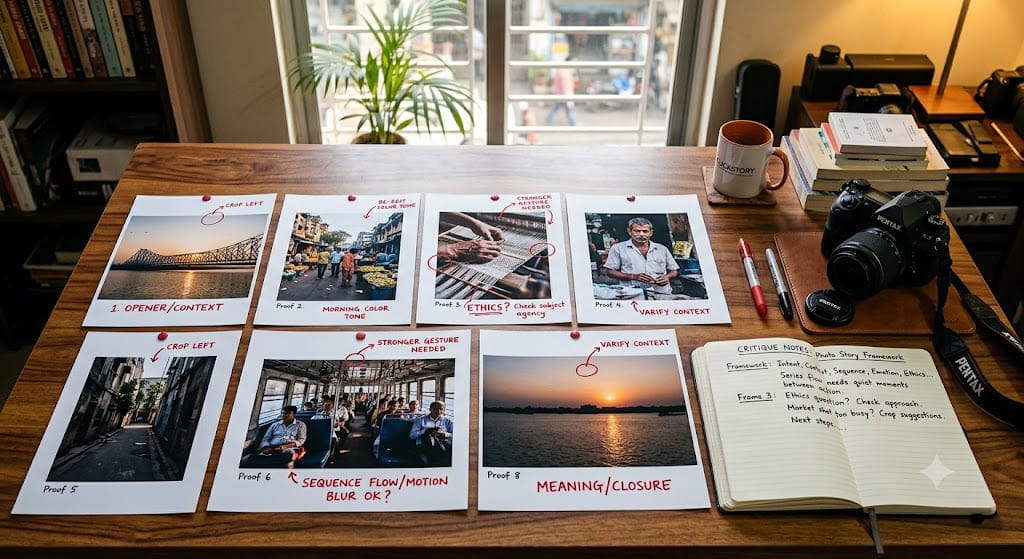
What Is Photo Story Critique?
Critiquing a photo story is the deliberate process of analyzing how a structured set of images communicates a cohesive narrative, mood, or idea.
It is fundamentally different from reviewing a single photograph. A single-image critique evaluates elements like isolation, geometry, and moment-in-time exposure. A photo story critique evaluates relationship, rhythm, context, and progression.
Critique is not simple criticism. It is not about declaring whether a series is “good” or “bad,” nor is it about listing technical flaws. Instead, a true critique asks three foundational questions:
- What is the work trying to say?
- How effectively do the visual tools say it?
- What is the broader impact or meaning of that message?
A photo story critique does not treat technical perfection as the ultimate goal. A crisp image with terrible context or unethical staging is still a failed story image.
Why Does Photo Story Critique Matter in Visual Storytelling?
In an era dominated by high-resolution smartphone cameras and automated editing, technical competence has been democratized. Almost anyone can execute a sharp, well-lit single image. However, single images often function as aesthetic noise in high-volume environments like social media feeds.
Photo stories demand sustained attention, thoughtful pacing, and narrative structure.
[Intent] ──► [Context] ──► [Composition] ──► [Sequence]
│
[Meaning] <—- [Ethics] <—- [Originality] <—- [Emotion]
A technically flawless image can still ruin a photo story if it fails to move the narrative forward or breaks the visual tone. When you learn to critique photo stories, you shift from being a passive consumer of images to an active reader of visual texts. For photographers, reading work critically directly refines how you shoot: you stop hunting for random single frames and start looking for connections, context, and structural integrity.
1. Intent
What is the core theme or thesis of this series? Intent is the baseline against which all choices are measured. An essay intended to show the quiet dignity of manual labor should feel vastly different from one intended to highlight labor exploitation.
2. Context
Does the viewer understand where, when, and why this story takes place? Look for establishing shots, environmental cues, and cultural context. If a series requires a three-page essay to be understood, the visual context has fallen short.
3. Composition & Visual Pacing
How are individual elements arranged inside the frame to direct the reader’s eye? Analyze how focal length, scale, perspective, and framing choices serve the broader story rather than showcasing technique for its own sake.
4. Sequence & Structure
How do the photographs move from one frame to the next? A strong sequence relies on variation—combining wide establishing shots, medium interactions, and detailed close-ups to build a dynamic visual rhythm.
5. Emotion & Atmosphere
Does the work evoke empathy, curiosity, tension, or quiet contemplation? Evaluate whether the emotional tone feels genuine or manipulated through forced staging or overly dramatic editing styles.
6. Originality & Perspective
Does the story offer a distinct viewpoint, or does it fall back on visual tropes? Look for fresh vantage points1, unexpected moments, and genuine access that break away from clichéd representations.
7. Ethics & Representation
How does the photographer relate to their subject? Examine power dynamics, agency, and truthfulness. Ask whether the images empower the subjects or exploit them for aesthetic impact.
8. Meaning & Resonance
What does the series communicate beyond its immediate subject matter? Does it connect a personal story to broader human, social, or cultural themes?
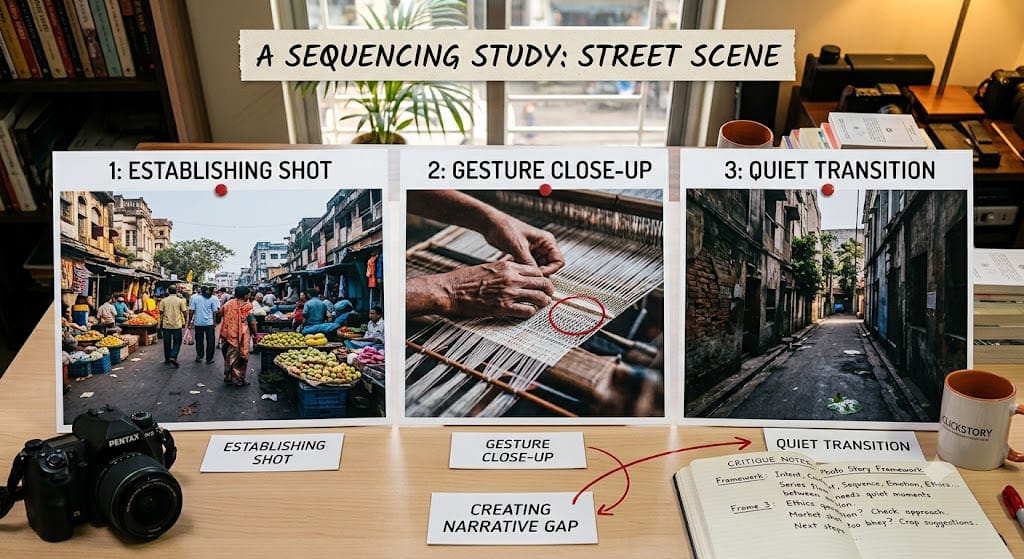
How to Apply the Framework When Shooting
Critique is not just a tool for reviewing completed work; it is an active shooting framework. Use this practical workflow during production to ensure your narrative holds up under analysis:
- Define the Thesis: State your story’s purpose in a single sentence before raising your camera.
- Build a Visual Map: Plan to shoot a mix of wide, medium, close-up, and detail frames to ensure you have structural variation.
- Anchor in Context: Photograph signs, architecture, tools, and environments that anchor the location and time period without relying on captions.
- Focus on Gestures and Relationships: Wait for authentic human interactions, subtle hand gestures, and eye contact rather than posed reactions.
- Audit Your Sequence On-Site: Review your captured frames periodically to spot missing elements—such as a missing transition frame or an overload of repetitive medium shots.
- Edit Relentlessly: Select only the frames that advance the story, eliminating visually striking images that fail to add new information.
Camera Settings and Technical Considerations
Technical choices in a photo story should serve narrative function, not technical perfection.
| Camera Parameter | Technical Choice | Storytelling Function |
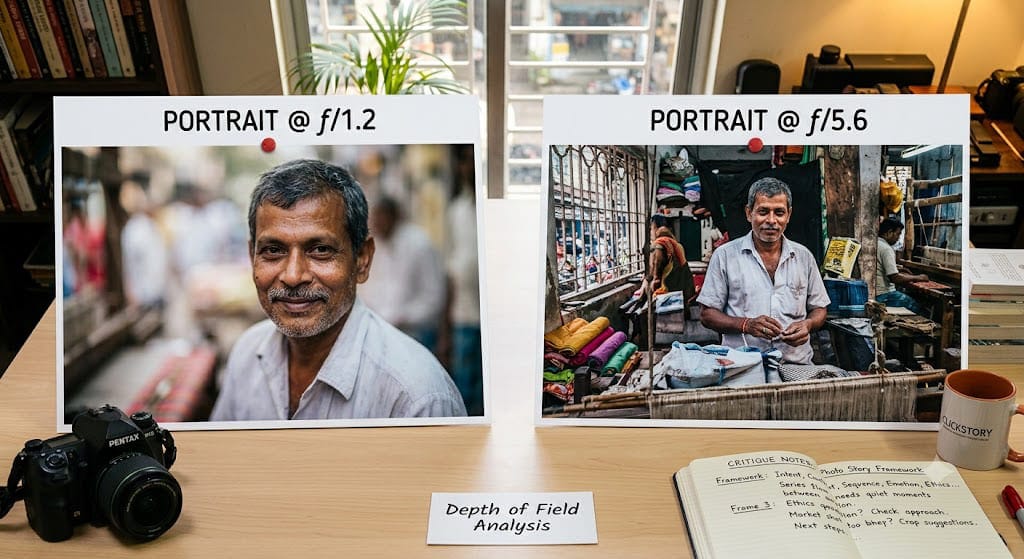
| Aperture | Closed down (f/5.6 – f/11) | Retains background details essential for establishing location and environmental context. |
| Aperture | Wide open (f/1.4 – f/2.8) | Isolate specific subject details or emotional gestures by eliminating background clutter. |
| Shutter Speed | Slow (1/15s – 1/30s) | Introduces intentional motion blur to convey energy, movement, or passage of time. |
| Shutter Speed | Fast (1/500s+) | Freezes precise, fleeting gestures, micro-expressions, or decisive action moments. |
| Focal Length | Wide (24mm – 35 mm) | Places the viewer directly inside the environment, creating an intimate, immersive feel. |
| Focal Length | Telephoto (85mm+) | Compresses space to highlight specific interactions, though overusing it can disconnect subjects from their environment. |
Building a Stronger Visual Story
A series of isolated, striking images does not make a photo story. To create narrative depth, your sequence needs structural variety and intentional pacing.
- The Opener (Establishing Shot): Sets the physical setting, time, and mood.
- The Character / Subject Introduction: Establishes who or what the story centers around within their environment.
- The Interaction / Action: Captures relationships, labor, movement, or key conflicts.
- The Detail Shot: Draws attention to small elements—worn hands, discarded objects, textural elements—that symbolize broader themes.
- The Quiet / Transition Moment: Provides a visual breath, giving the viewer space to process the narrative build-up.
- The Closer: Offers a sense of resolution, reflection, or lingering questions, bringing the visual arc to a natural end.

Real-World Photography Examples
Scenario 1: Street Photography — Morning Commute in Kolkata
- Situation: Capturing the energy of early morning commuters crossing the Howrah Bridge.
- Intention: Contrast the mass collective rush with individual moments of isolation.
- What to Photograph: Wide environmental shot of the foggy bridge, medium shot of hand-pulled rickshaw pullers moving against traffic, close-up of hands gripping a rusted railing, portrait of a commuter looking out a bus window.
- Why It Works: Moves from macroeconomic scale to individual human experience.
- Viewer’s Takeaway: Understands both the physical scale of the location and the personal, human rhythm of the city.
Scenario 2: Cultural Event — Durga Puja Artisan Workshops in Kumartuli
- Situation: Documenting the clay idol makers preparing for the festival.
- Intention: Highlight the physical labor and artistic dedication behind a grand public festival.
- What to Photograph: Wide view of narrow, clay-dusted lanes, close-up of fingers detailing an idol’s eye, low-angle shot of an artisan resting under a half-finished sculpture.
- Why It Works: Avoids festival spectacle to focus on craft, labor, and process.
- Viewer’s Takeaway: Gains a deeper respect for the human labor behind a major cultural celebration.
Scenario 3: Family / Personal Documentary — A Craftisan’s Daily Routine
- Situation: Documenting a family-run handloom weaving workshop in rural India.
- Intention: Show how tradition, family life, and economic survival intersect within a single home.
- What to Photograph: Wide shot of the loom setup inside the living space, medium shot of a parent guiding a child’s hand on the thread, detailed close-up of worn wooden shuttles, quiet portrait at the end of the workday.
- Why It Works: Bridges the gap between home life and historical labor practices.
- Viewer’s Takeaway: Connects an abstract textile product to the lived experience of the family producing it.
Common Mistakes Photographers Make
- Chasing Standalone “Hero” Shots: Focusing entirely on striking individual frames instead of images that build a narrative together.
- Context Erasure: Overusing extreme shallow depth-of-field (f/1.2−f/1.8), which blurs out essential background information.
- Repetitive Focal Lengths: Shooting an entire project using only one lens angle (e.g., all 50mm eye-level shots), causing visual monotony.
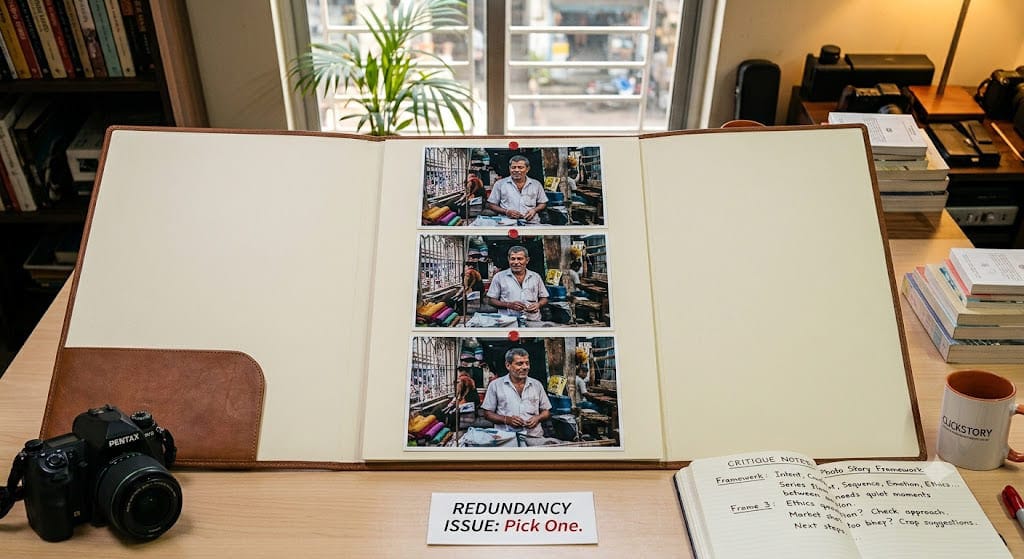
- Visual Redundancy: Including four variations of the same moment rather than picking the single strongest frame.
- Over-Editing and Heavy Stylization: Using aggressive color presets or contrast that distracts from the subject matter.
- Ignoring Quiet Moments: Including only high-energy action shots without quiet, reflective scenes to balance the narrative pace.
- Ethical Disconnect: Photographing vulnerable subjects without taking time to understand their situation or gain genuine consent.
How to Improve Weak Results
If the story looks visually beautiful but feels emotionally flat:
- Problem: Too much emphasis on composition and lighting, not enough focus on human gesture or interaction.
- Fix: Move closer. Focus on facial expressions, body language, and moments of unposed connection.
If the sequence feels repetitive or boring:
- Problem: Lack of scale and structural variation in your shots.
- Fix: Enforce a strict variety rule in your edit: never place two images of the same focal distance side-by-side.
If the viewer does not understand the context:
- Problem: The series lacks establishing or environmental anchors.
- Fix: Add a wider scene-setting image or an environmental portrait that reveals location, culture, or time period.
If the narrative feels disjointed or chaotic:
- Problem: No clear visual or thematic thread linking the images.
- Fix: Standardize your visual approach—maintain consistent color tones, lighting, or framing styles across the series.
Creative Ways to Use the Framework
Advanced storytellers break conventional rules to build deeper meaning:
- Embrace Ambiguity: Leave key questions unanswered in individual frames to encourage the viewer to look closer and engage with the sequence.
- Visual Metaphor: Use environmental textures or shadows to represent internal emotional states.
- Juxtaposition: Place contrasting images side by side (e.g., wealth next to poverty, young next to old) to create friction and commentary.
- Minimalism and Silence: Use empty space within frames to evoke feelings of isolation, loss, or quiet transition.

Photo Story Critique in Contemporary Photography
Contemporary photography demands critical attention to ethics, representation, and digital authenticity.
When critiquing modern photo stories, evaluate whether the photographer engages respectfully with their subjects or imposes an outside perspective. Ask yourself:
- Does the work afford the subject dignity and agency?
- Is the photographer acknowledging their own perspective and potential biases?
- How does the work perform across different platforms—from traditional gallery walls to vertical smartphone screens?
In an era of generative AI and heavy manipulation, evaluating the authenticity of moments and context has become essential. A critique must assess whether an image preserves genuine observational truth or relies on artificial manipulation that compromises the story’s integrity.
How Photo Critics Can Analyze a Photo Story
Use these core critical questions when reviewing any visual project:
- Thesis: What primary message or mood is the photographer trying to communicate?
- Contextual Completeness: Does the series supply enough visual information for the viewer to understand the setting without captions?
- Pacing & Flow: How does the visual energy shift across the sequence? Where does the viewer pause, and where do they move forward?
- Ethical Stance: Does the image sequence honor the subject’s agency, or does it exploit their circumstances for aesthetic gain?
- Resonance: Does the project offer fresh insights into its theme, or does it fall back on visual clichés?
Practical Exercise: Critique Your Own Visual Narrative
Objective
Learn to edit and critique a 5-image photo essay using the 8-pillar framework.
Location
A local market, community workshop, or public transport hub.
Time
1 to 2 hours of active shooting.
Equipment
Any camera or smartphone with a fixed lens or prime focal length setting.
Rules
- Capture at least 50 images during the session.
- Edit the final selection down to exactly 5 images.
- The 5 images must include: 1 Establishing Wide Shot, 1 Medium Character Shot, 1 Detail/Close-Up Shot, 1 Action/Interaction Shot, and 1 Resolving/Closing Shot.
- No duplicate shot types allowed side-by-side in the final edit.
Reflection Questions
- What is the single-sentence story my 5-image edit tells?
- Which image provides the strongest context?
- Which frame carries the deepest emotional weight?
- What detail or information is missing from the overall sequence?
- How does the story’s meaning change if I rearrange the sequence order?
Conclusion
A great photograph captures a single moment; a great photo story builds a lasting narrative.
When evaluating work—whether your own or someone else’s—remember that technical perfection is merely a tool, not the goal. True visual storytelling lives in the balance of Intent, Context, Sequence, and Ethics. Stop asking if an image is pretty; start asking what it builds when brought together with others.
Frequently Asked Questions (FAQ)
Q1: How many photos should be in a standard photo story? A1: Most compelling photo essays consist of 5 to 12 images. Fewer than 5 often lacks narrative depth, while more than 12 risks visual redundancy unless produced for a book or long-form documentary project.
Q2: Can a photo story work without captions or text? A2: Yes. A strong photo story should communicate its core context, mood, and narrative visually. Captions should provide names, dates, and background facts, but they should not have to carry the weight of explaining what is happening visually.
Q3: What is the single most common mistake in beginner photo essays? A3: Visual redundancy. Beginners often include multiple photos of the same subject taken from similar distances, rather than varying their framing with wide, medium, close-up, and detail shots.
Q4: Is technical flawlessness necessary for a good photo story? A4: No. Emotional resonance, narrative clarity, and strong context frequently outweigh minor technical imperfections like slight motion blur or high ISO grain.
Q5: How do I know if my photo sequence flows well? A5: Print your images or lay them out side by side on a screen. Look at how your eyes move across them. If two adjacent images feel too similar in scale or color tone, adjust the sequence or remove one.
Q6: How does editing affect the ethics of a photo story? A6: Over-editing—such as cloning out background elements or manipulating colors heavily—can alter the factual truth of a scene. In documentary storytelling, edits should preserve the context and reality of the moment captured.
- A vantage point is a physical place or a mental position that gives you a clear and good view of something. ↩︎
