

What Is Studio Photography? A Complete Beginner’s Guide
Studio photography is one of the most powerful and versatile branches of photography, offering complete control over light, shadows, colors, backgrounds, and the overall environment. Unlike outdoor photography, where harsh sunlight, unexpected rain, or changing weather can affect a session, a studio provides a controlled space where every element can be carefully planned and adjusted. This level of control allows photographers to create consistent, creative, and professional images while focusing entirely on the subject and the desired visual style.
Whether you’re photographing a person’s smile, a luxury watch, a plate of gourmet food, or a fashion collection, a photography studio allows you to create images with consistency, precision, and creativity. While many photographers begin their journey outdoors using natural light, most eventually discover that mastering studio photography opens an entirely new world of possibilities.
In this guide, you’ll learn what studio photography is, how it evolved, why professionals continue to rely on it, how it differs from natural-light photography, and the different types of studios available today. By the end, you’ll have a solid foundation for understanding everything else in this complete studio photography series.
The Power of a Controlled Studio Environment
Studio photography is the practice of creating photographs inside a controlled indoor environment where the photographer manages nearly every aspect of the image. Unlike outdoor photography, where sunlight and weather dictate the lighting conditions, a studio gives complete authority over illumination, shadows, backgrounds, color, and atmosphere.
The defining feature of studio photography is control. Every light source is positioned intentionally. Every shadow is created—or removed—with purpose. Every background is chosen to support the subject rather than compete with it. Instead of waiting for the perfect weather or ideal golden-hour sunlight, photographers build the lighting they need using flashes, continuous lights, softboxes, reflectors, and other light modifiers.
This level of control allows photographers to produce images that are consistent, repeatable, and tailored to a specific creative vision. Whether the goal is a clean corporate headshot, a dramatic fashion portrait, or a flawless product photograph for an online store, the studio becomes a space where imagination is translated into carefully crafted images.
Contrary to a common misconception, studio photography is not limited to professional photographers working in large commercial spaces. Today, many photographers create stunning studio images from spare bedrooms, garages, basements, or even a small corner of their living room. Advances in affordable LED lights, compact flashes, collapsible backdrops, and lightweight modifiers have made studio photography more accessible than ever.
In simple terms, studio photography is about shaping light rather than chasing it.
A Brief History of Studio Photography
Studio photography has evolved alongside the history of photography itself. In the mid-19th century, when photographic processes required long exposure times, photographers established studios with large skylights or glass roofs to maximize the available sunlight. Artificial lighting was either unavailable or impractical, so natural daylight remained the primary source of illumination.
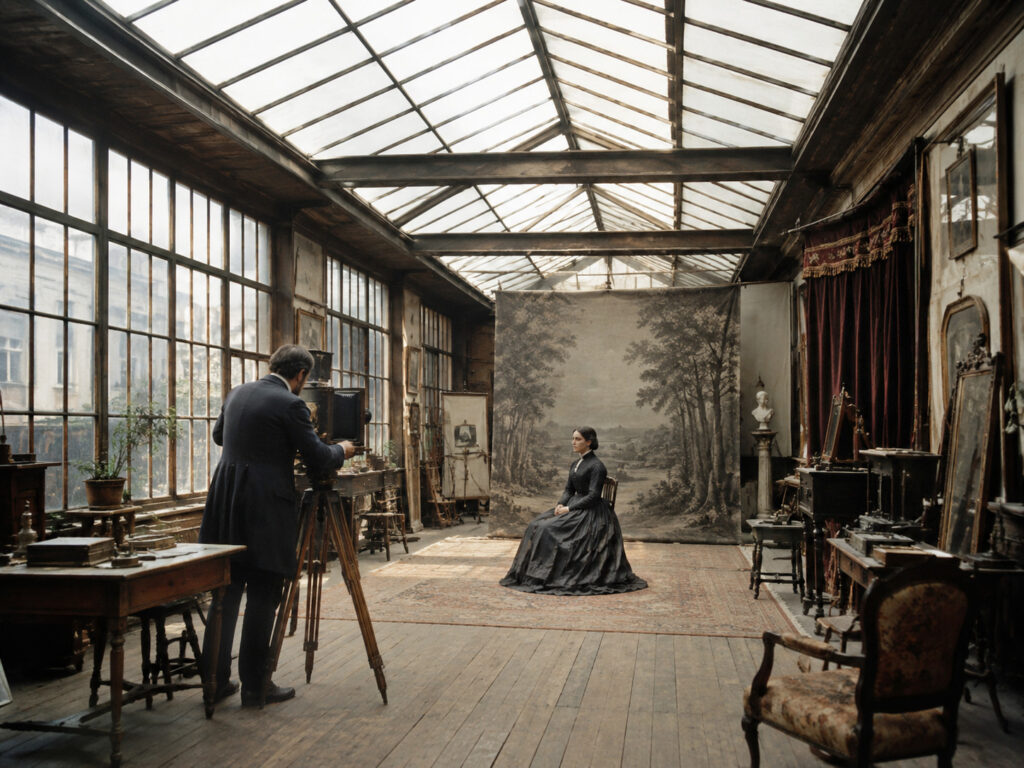
These early studios were carefully designed to capture as much daylight as possible. Subjects often had to remain perfectly still for several seconds—or even minutes—to avoid blur. Portrait sessions demanded patience from both photographers and clients.
The invention of electric lighting transformed studio photography. By the early twentieth century, photographers gradually replaced dependence on daylight with artificial illumination, allowing them to work regardless of weather or time of day. As flash technology advanced, photographers gained unprecedented control over exposure, contrast, and creative effects.
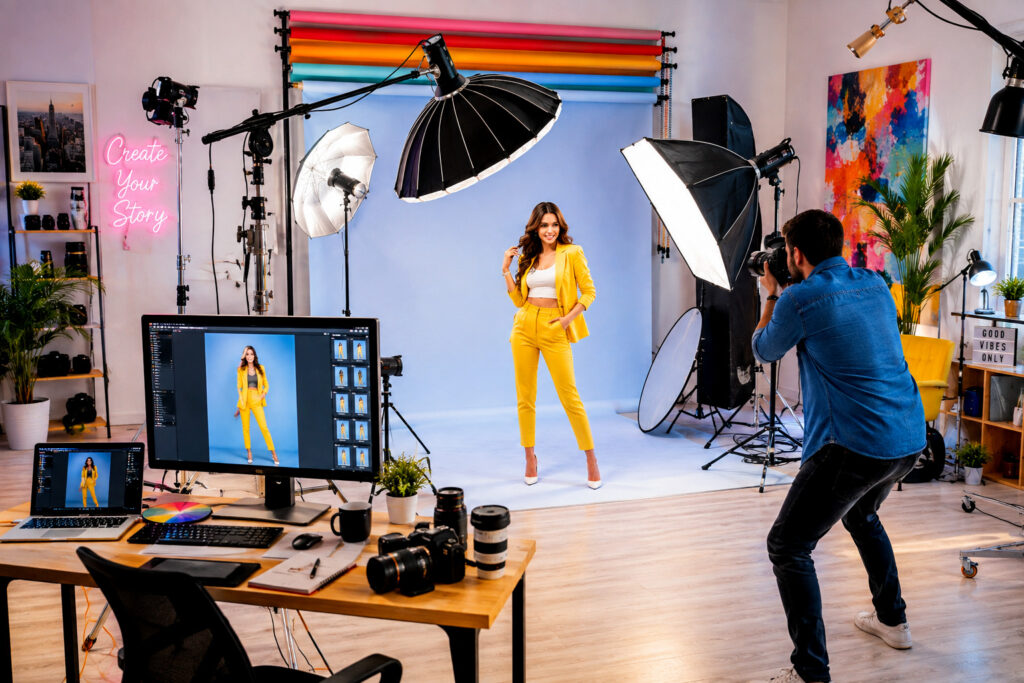
The digital revolution accelerated this transformation even further. Modern mirrorless cameras, wireless flash triggers, powerful battery-operated strobes, high-quality LED lights, tethered shooting systems, and advanced editing software have made professional studio photography faster, more efficient, and remarkably flexible.
Today, studio photography serves countless industries, including portraiture, fashion, advertising, product photography, food photography, beauty campaigns, corporate branding, e-commerce, fine art, and social media content creation. What began as a necessity has become one of the most refined forms of visual storytelling.
Why Photographers Still Use Studios
If smartphones now produce excellent images and outdoor locations offer beautiful natural light, why do professional photographers continue investing in studios?
The answer lies in one word: consistency.
Professional photographers often need to recreate the same look across multiple sessions, products, or campaigns. A cosmetics brand may require hundreds of product images with identical lighting. A company might need employee portraits taken over several months that appear as though they were photographed on the same day. Achieving this level of consistency outdoors is almost impossible because natural light changes constantly.
A studio eliminates these variables.
Photographers can precisely adjust the brightness, direction, softness, and color of each light. They can position backgrounds exactly where they need them, remove distractions, and fine-tune every detail before pressing the shutter. The result is a predictable workflow and images that meet professional standards.
Studios also encourage experimentation. Want dramatic shadows for a cinematic portrait? Place a gridded light at an angle. Need a bright, airy high-key look? Add a large softbox and a white background. Looking for moody low-key lighting? Control the spill of light and use darker backgrounds. In a studio, creative ideas can be tested repeatedly until the desired result is achieved.
For commercial photographers, this predictability translates into efficiency. Time spent waiting for clouds to move, sunlight to soften, or rain to stop is replaced by productive shooting time. Clients appreciate this reliability, especially when working on advertising campaigns or product launches with strict deadlines.
Ultimately, photographers use studios because they offer something no outdoor location can guarantee: complete creative control.
Studio Photography vs. Natural Light Photography
Both studio photography and natural-light photography have unique strengths. Neither is inherently better than the other; the right choice depends on your subject, creative vision, and shooting conditions.
Natural-light photography relies on sunlight or existing ambient light. It often produces organic, atmospheric images with minimal equipment, making it ideal for travel, street photography, landscapes, weddings, and environmental portraits. However, sunlight changes throughout the day, weather conditions can interrupt a shoot, and achieving consistent results may be challenging.
Studio photography, by contrast, uses artificial lighting to create repeatable conditions. Every element of the scene—from the intensity of the light to the placement of shadows—can be adjusted with precision. This makes it especially valuable for portraits, fashion editorials, commercial campaigns, product photography, beauty work, and e-commerce.
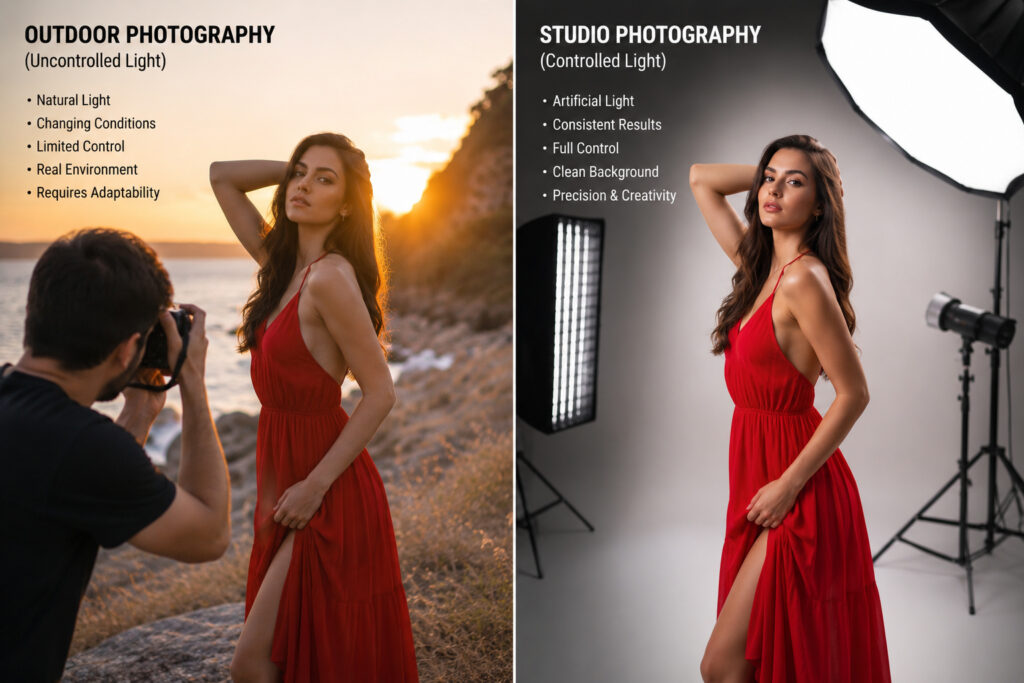
One of the greatest advantages of studio photography is that learning to control artificial light also improves your understanding of natural light. Concepts such as light direction, shadow quality, contrast, color temperature, and light falloff apply regardless of whether the light comes from the sun or a studio flash.
Rather than viewing studio and natural-light photography as competing approaches, many experienced photographers see them as complementary skills. Mastering both gives you the flexibility to create compelling images in almost any situation.
Different Types of Photography Studios
Not every photography studio looks the same. Studios are designed according to the subjects they photograph and the needs of the photographer.
- A portrait studio typically features seamless backgrounds, adjustable lighting systems, posing stools, and enough space for individual or family portraits.
- A product photography studio focuses on controlled tabletop setups, light tents, macro lenses, and precise lighting for everything from electronics to cosmetics and jewelry.
- A fashion studio usually offers higher ceilings, larger shooting areas, multiple lighting stations, dressing rooms, and space for models, stylists, and makeup artists to work together efficiently.
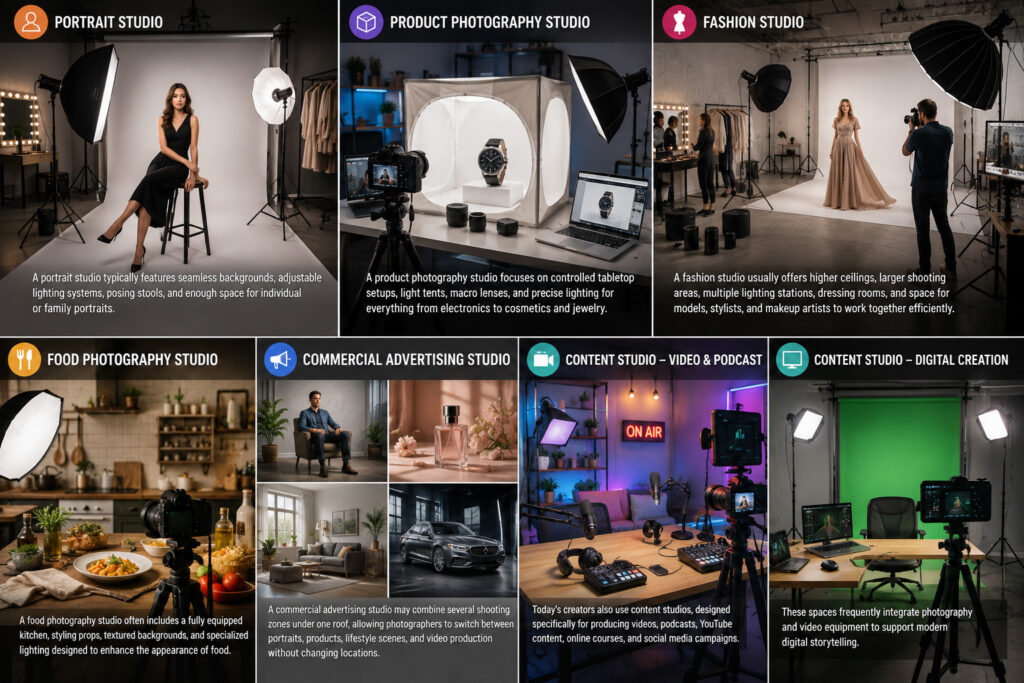
- A food photography studio often includes a fully equipped kitchen, styling props, textured backgrounds, and specialized lighting designed to enhance the appearance of food.
- A commercial advertising studio may combine several shooting zones under one roof, allowing photographers to switch between portraits, products, lifestyle scenes, and video production without changing locations.
Today’s creators also use content studios, designed specifically for producing videos, podcasts, YouTube content, online courses, and social media campaigns. These spaces frequently integrate photography and video equipment to support modern digital storytelling.
Each type of studio is built around a different workflow, but they all share one common goal: providing complete control over the photographic environment.
Home Studio vs. Commercial Studio
One of the biggest decisions aspiring photographers face is whether to build a home studio or rent a commercial one.
A home studio is an excellent starting point for beginners. It requires a relatively small investment and allows unlimited practice without rental fees. A spare bedroom, garage, basement, or even a corner of a living room can become an effective shooting space with thoughtful planning. Portable LED lights, speedlights, collapsible backdrops, and compact light modifiers make it possible to produce professional-quality images in surprisingly limited spaces.
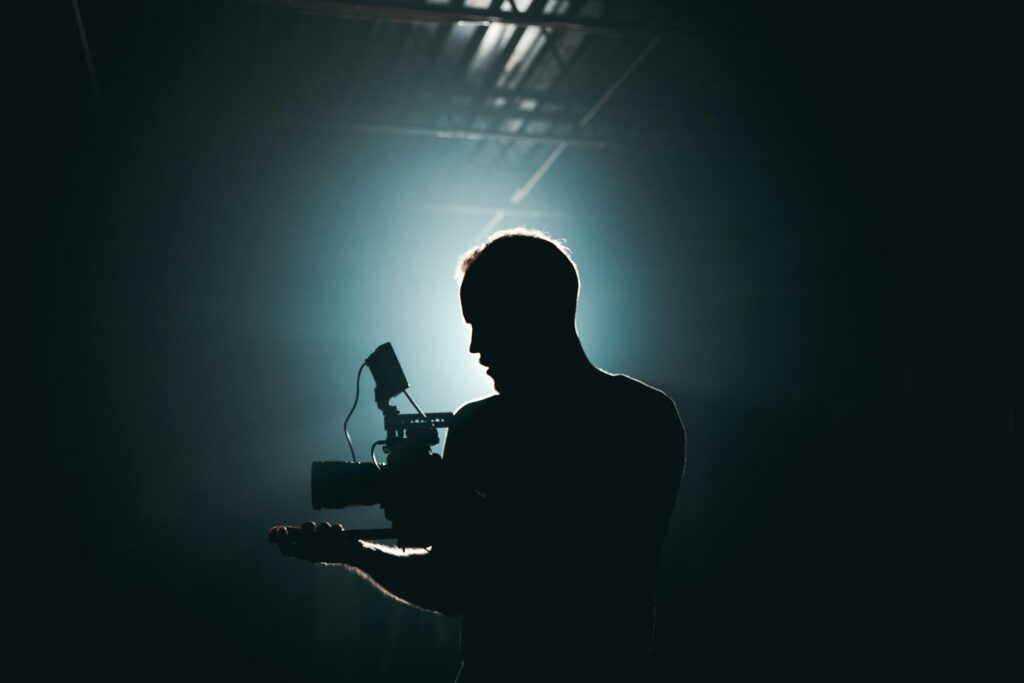
Working from home also provides flexibility. You can experiment with lighting, practice posing, test new equipment, and refine your workflow whenever inspiration strikes.
A commercial studio, on the other hand, offers more space, specialized equipment, and professional amenities. These studios often feature high ceilings, cyclorama walls, large backdrops, powerful lighting systems, makeup stations, changing rooms, storage areas, and comfortable client lounges. For large fashion shoots, advertising campaigns, group portraits, or video productions, these facilities can significantly improve efficiency.
Many professional photographers begin with a home studio and transition to commercial studios as their business grows. Others continue using both—handling smaller sessions at home while renting commercial spaces for projects that require additional room or specialized equipment.
The best choice depends on your budget, available space, shooting style, and long-term goals. What matters most is not the size of the studio but your ability to understand and shape light effectively.
Key Takeaways
Studio photography is much more than taking pictures indoors. It is the art of creating a controlled environment where light, shadow, color, and composition work together to produce consistent, high-quality images. From humble glass-roofed portrait studios of the nineteenth century to today’s sophisticated commercial spaces equipped with wireless lighting systems and digital workflows, studio photography has continually evolved while maintaining one fundamental principle: control leads to creativity.
Whether you dream of photographing portraits, products, fashion, food, or commercial campaigns, learning studio photography equips you with skills that extend far beyond the studio walls. Every lesson about light, exposure, and composition will make you a stronger photographer in any environment.
In the next section, we’ll explore the advantages of studio photography, including why professionals invest in studio equipment, how controlled lighting improves image quality, and the practical benefits that make studio photography indispensable across many genres. The move forward your knowledge based on various types of studio photography genres.
