

Types of studio photography go far beyond traditional portraiture. One of the greatest strengths of a photography studio is its versatility. The same space can be transformed from a portrait setup into a fashion environment, a product set, or even a miniature kitchen for food photography—all within a single day.
While the fundamentals of lighting, composition, and camera control remain common across different genres, each type of studio photography has its own purpose, workflow, equipment, and creative challenges. A portrait photographer may concentrate on shaping light and capturing expression, while a product photographer may focus on reflections, textures, and precise details.
Understanding these differences can help you choose the right equipment, lighting techniques, backgrounds, and shooting approach for the kind of images you want to create.
Whether you are taking your first steps into photography or planning to specialize professionally, exploring the different types of studio photography will give you a better understanding of what a studio can offer. From portraits, fashion, and beauty to products, food, advertising, and fine-art photography, the possibilities are remarkably diverse.
1. Portrait Photography
Portrait photography is perhaps the most recognizable and widely practiced form of studio photography. Its primary goal is to capture a person’s personality, emotions, and character rather than simply recording their appearance.
Studio portraits are popular for:
- Individual portraits
- Family photographs
- Graduation portraits
- Senior portraits
- Personal branding
- Social media profiles
- Fine-art portraits
Because the studio offers complete control over lighting, photographers can shape facial features, soften skin tones, create dramatic shadows, or produce bright, high-key portraits depending on the desired mood.
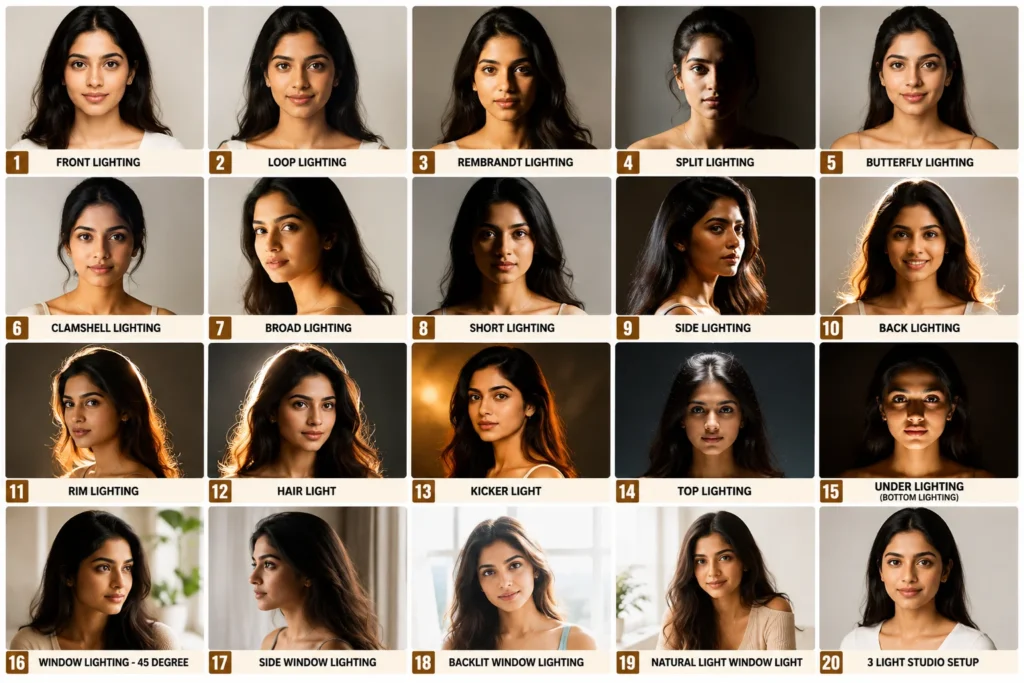
Common lighting patterns include:
- Butterfly lighting
- Loop lighting
- Rembrandt lighting
- Split lighting
- Clamshell lighting
Portrait photography is an excellent starting point for photographers because it teaches the fundamentals of lighting, posing, composition, and communication with subjects.
2. Fashion Photography
Fashion photography combines technical skill with artistic storytelling. While the clothing is the main focus, successful fashion images also communicate style, luxury, and brand identity.
Studio fashion photography is commonly used for:
- Clothing brands
- Designer collections
- Fashion magazines
- Catalogs
- Online stores
- Advertising campaigns
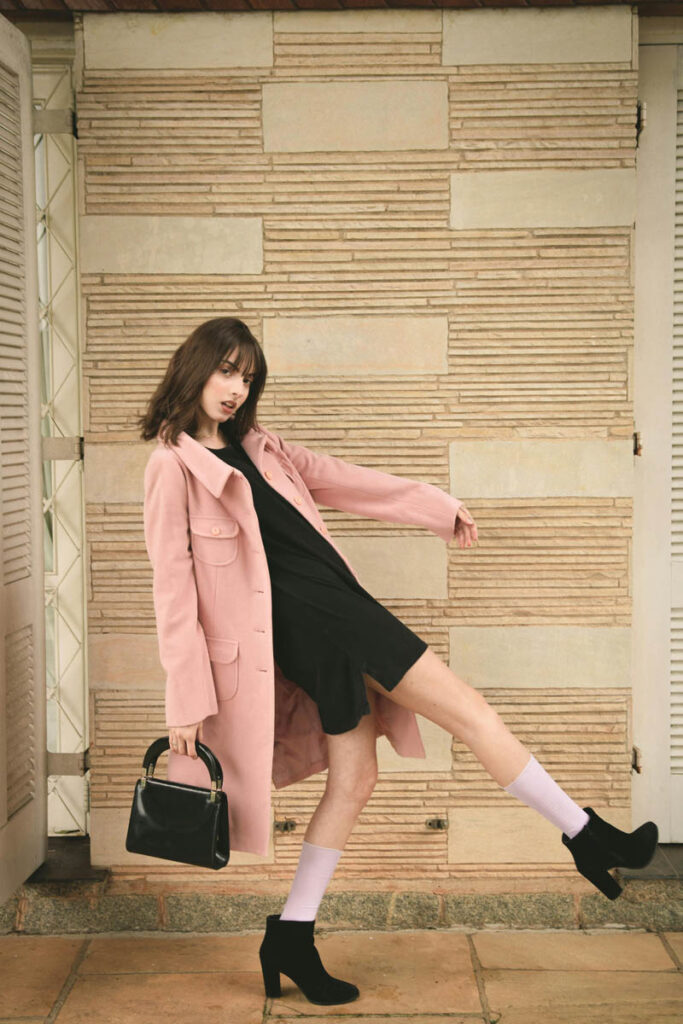
Fashion studios often feature:
- Large shooting spaces
- Multiple lighting setups
- Full-length backdrops
- Changing rooms
- Makeup stations
Photographers frequently use large softboxes, beauty dishes, strip lights, and rim lighting to highlight fabrics, textures, and body contours while creating a polished, editorial look.
3. Beauty Photography
Beauty photography focuses on close-up portraits that emphasize facial features, makeup, skincare, and hair.
Unlike traditional portrait photography, beauty photography demands extraordinary attention to detail because every skin texture, eyelash, and makeup application becomes visible.
Beauty photography is widely used for:
- Cosmetic brands
- Makeup artists
- Skincare companies
- Haircare advertisements
- Editorial magazines
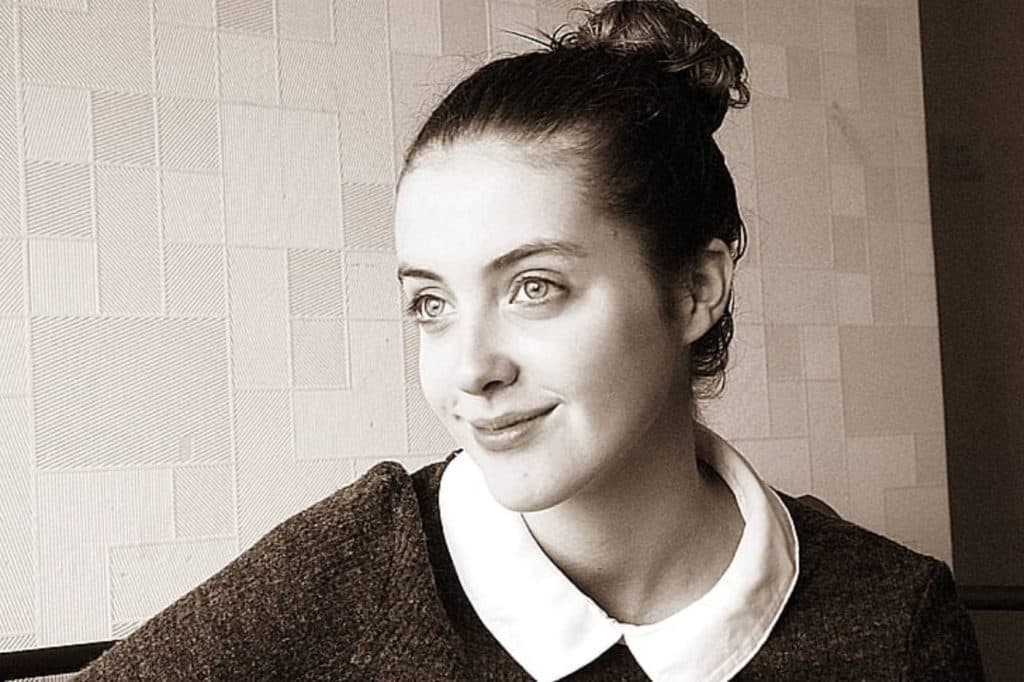
Soft, even lighting is essential to produce flattering skin tones while preserving fine detail. Macro lenses or short telephoto lenses are often preferred for capturing crisp facial details without distortion.
4. Product Photography
Product photography has become one of the fastest-growing areas of studio photography thanks to e-commerce and online marketplaces.
Its purpose is simple: Present products accurately while making them visually appealing. Typical subjects include:
- Electronics
- Cosmetics
- Watches
- Jewelry
- Kitchenware
- Clothing
- Furniture
- Handmade crafts
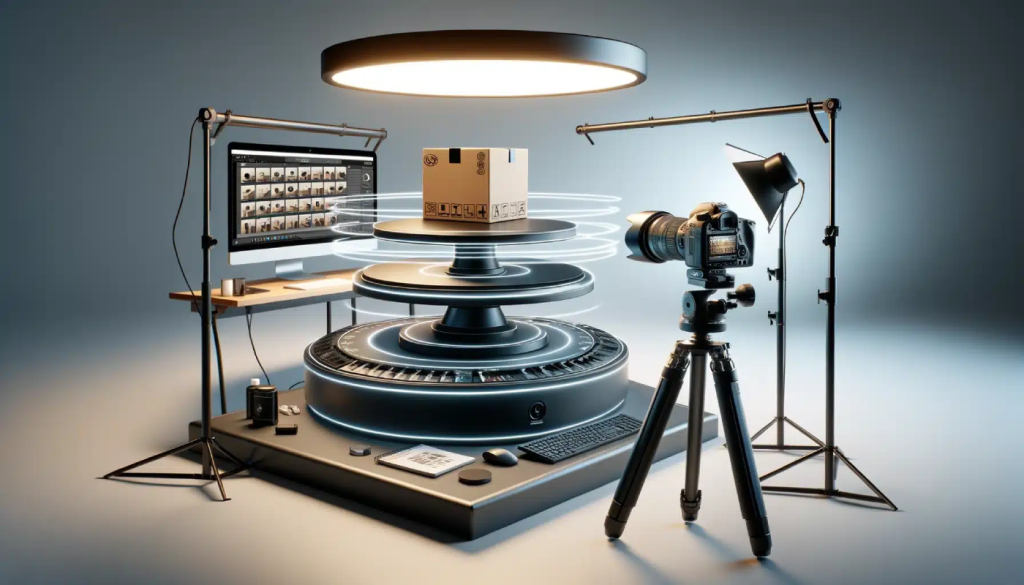
Successful product photography requires careful attention to:
- Reflections
- Color accuracy
- Texture
- Sharpness
- Background cleanliness
- Consistent lighting
Even a simple white-background product image may require several carefully positioned lights to eliminate unwanted reflections and shadows.
5. Jewelry Photography
Jewelry photography is one of the most technically demanding studio specialties. Small reflective surfaces create numerous lighting challenges.
Photographers must control:
- Specular highlights
- Reflections
- Dust
- Fingerprints
- Gemstone sparkle
- Metal texture
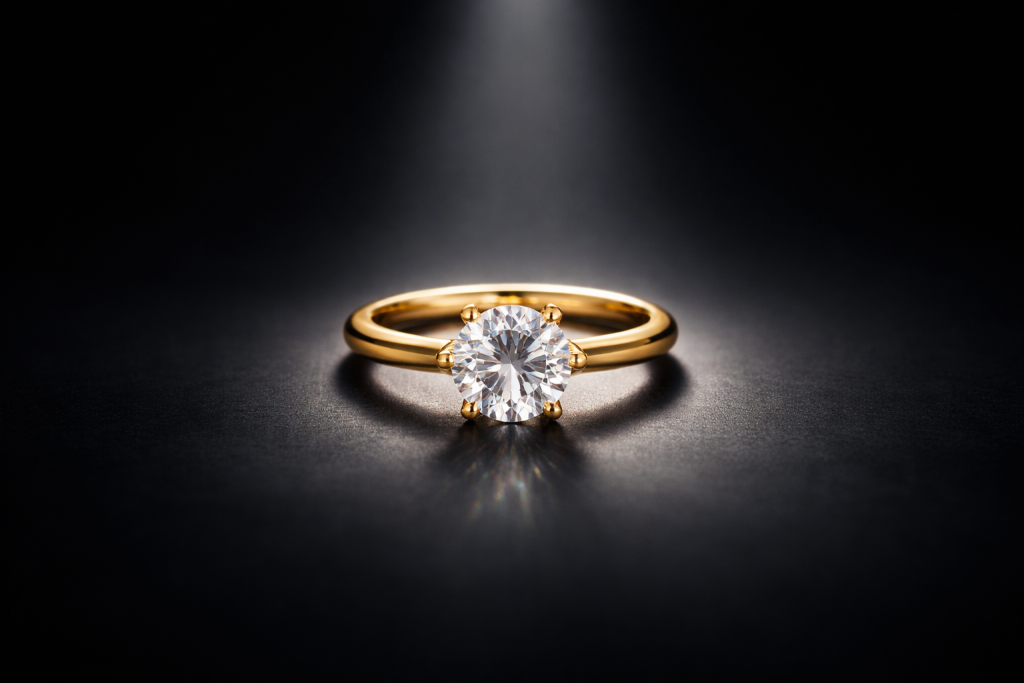
Specialized equipment often includes:
- Macro lenses
- Focus stacking
- Light tents
- Diffusers
- Precision lighting
Patience and meticulous preparation are essential because even tiny imperfections become highly visible at close distances.
6. Food Photography
Food photography is both an artistic and commercial discipline. Its goal is to make viewers feel hungry before they even taste the food.
Restaurants, publishers, chefs, food bloggers, and advertising agencies rely heavily on studio food photography because lighting and composition remain completely controllable.
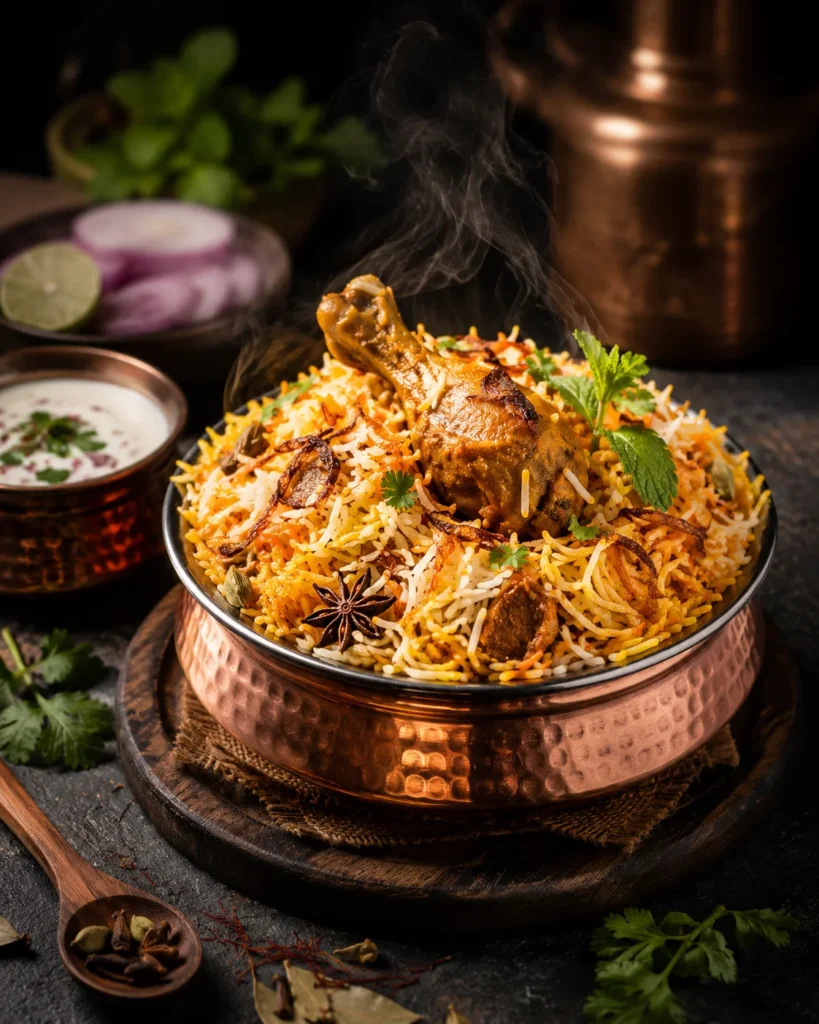
Important considerations include:
- Food styling
- Steam effects
- Garnishing
- Color harmony
- Surface textures
- Tableware
- Props
Soft directional lighting often imitates natural window light, creating fresh and inviting images. Timing also matters, as many foods lose their visual appeal quickly after preparation.
7. Commercial Photography
Commercial photography focuses on creating images that help businesses sell products or services. Unlike purely artistic photography, commercial images are designed with marketing objectives in mind.
Typical assignments include:
- Advertising campaigns
- Company brochures
- Product launches
- Website banners
- Billboards
- Social media promotions
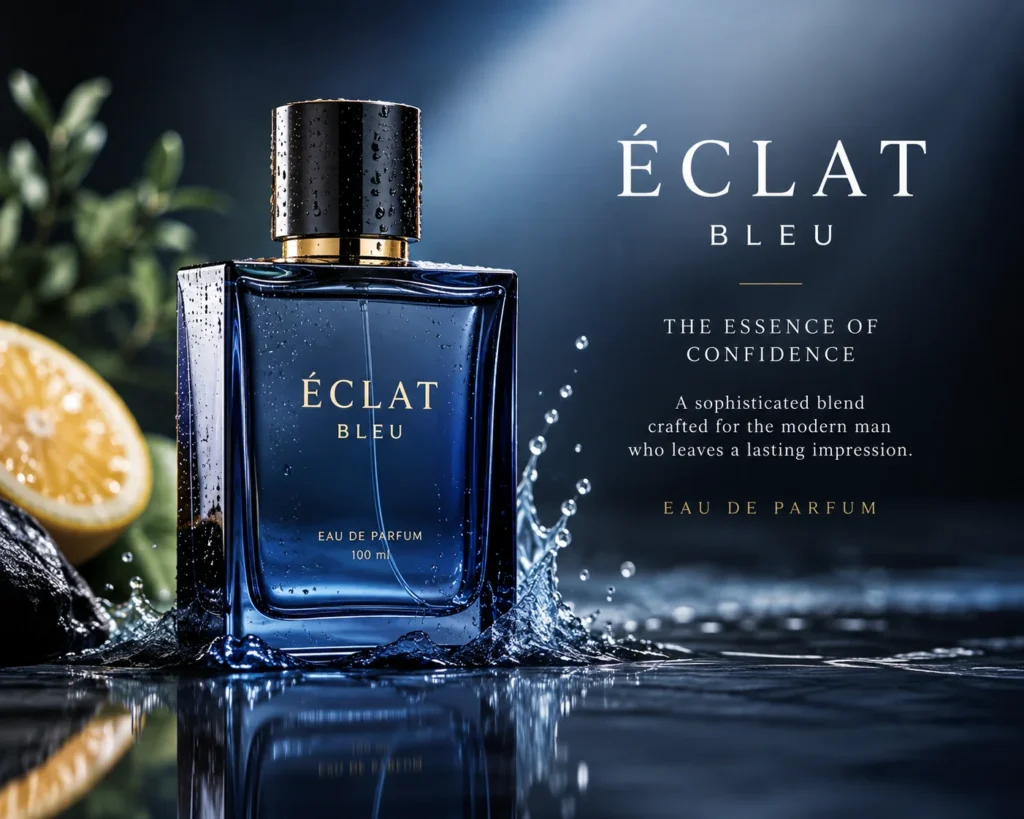
Commercial photographers frequently collaborate with:
- Art directors
- Marketing teams
- Graphic designers
- Stylists
- Brand managers
Studio control ensures consistency across every image in a campaign.
8. Advertising Photography
Advertising photography shares similarities with commercial photography but often places greater emphasis on storytelling and visual impact.
Rather than simply documenting a product, advertising photography creates an emotional connection with the audience.
For example, a luxury watch advertisement isn’t just about showing the watch—it conveys elegance, precision, and prestige through lighting, composition, props, and styling.
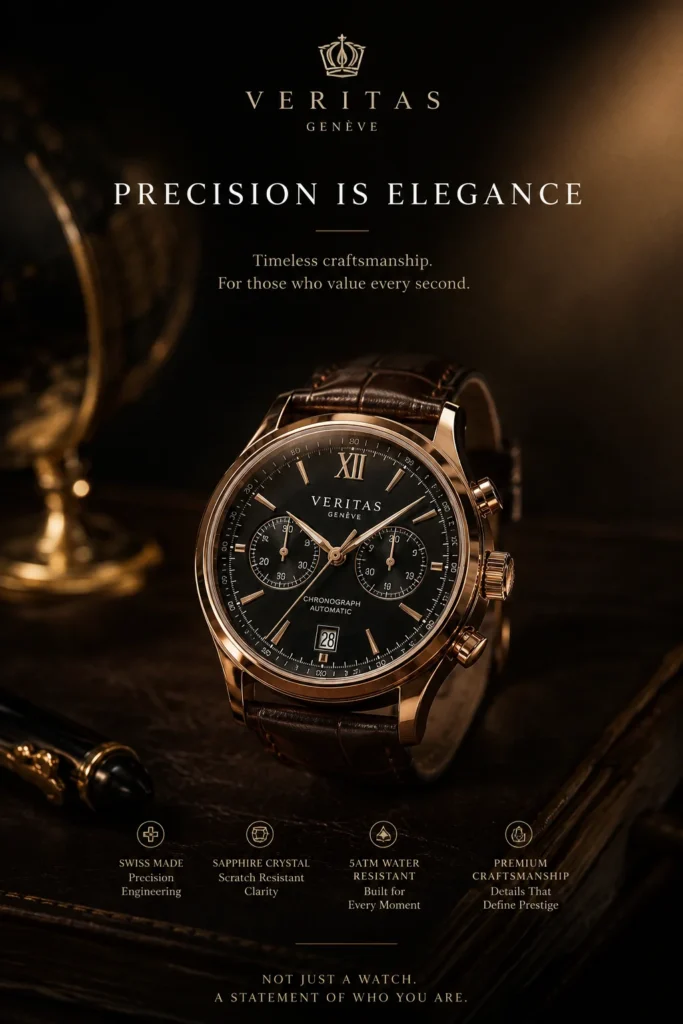
Advertising shoots frequently involve:
- Complex lighting
- Elaborate sets
- Creative concepts
- Extensive post-processing
Many advertising images are composites built from multiple photographs captured inside the studio.
9. Fine Art Photography
Fine art photography allows photographers to express ideas, emotions, and personal vision rather than meeting commercial objectives. Studios provide complete creative freedom for building conceptual scenes using:
- Dramatic lighting
- Costumes
- Smoke
- Fabrics
- Projection effects
- Hand-painted backgrounds
- Creative props
Every visual element is intentionally designed to support the artist’s message. There are few technical limits, making fine art one of the most imaginative studio genres.
The main technical limits include:
- Resolution: Limited resolution can affect heavy cropping and very large prints.
- Dynamic range: Extremely bright or dark areas may lose detail.
- ISO and noise: High ISO can introduce noise and reduce image quality, although grain can sometimes enhance the artistic effect.
- Lens limitations: Distortion, flare, vignetting, chromatic aberration, and softness can affect the image—but may also become creative elements.
- Depth of field: The photographer cannot always keep everything sharp, especially in difficult lighting or close-up situations.
- Motion: Slow shutter speeds can create unwanted blur, but intentional blur can communicate movement or emotion.
- Colour: Cameras, monitors, and printers reproduce colour differently, making accurate colour management important.
- Post-processing: Editing can improve an image, but cannot fully recover information that was never captured.
- Printing: Paper, ink, printer capability, and print size can all limit how faithfully an image is reproduced.
The key distinction is that a technical imperfection is not necessarily an artistic failure. Noise, blur, softness, distortion, or unusual colour can become part of the creative language of a fine art photograph.
In fine art photography, the goal is not always to eliminate technical limitations, but to understand them and decide when they should be controlled, accepted, or deliberately used.
10. Editorial Photography
Editorial photography illustrates stories published in magazines, newspapers, books, or online publications. Although many editorial images are photographed on location, studio environments are frequently used for:
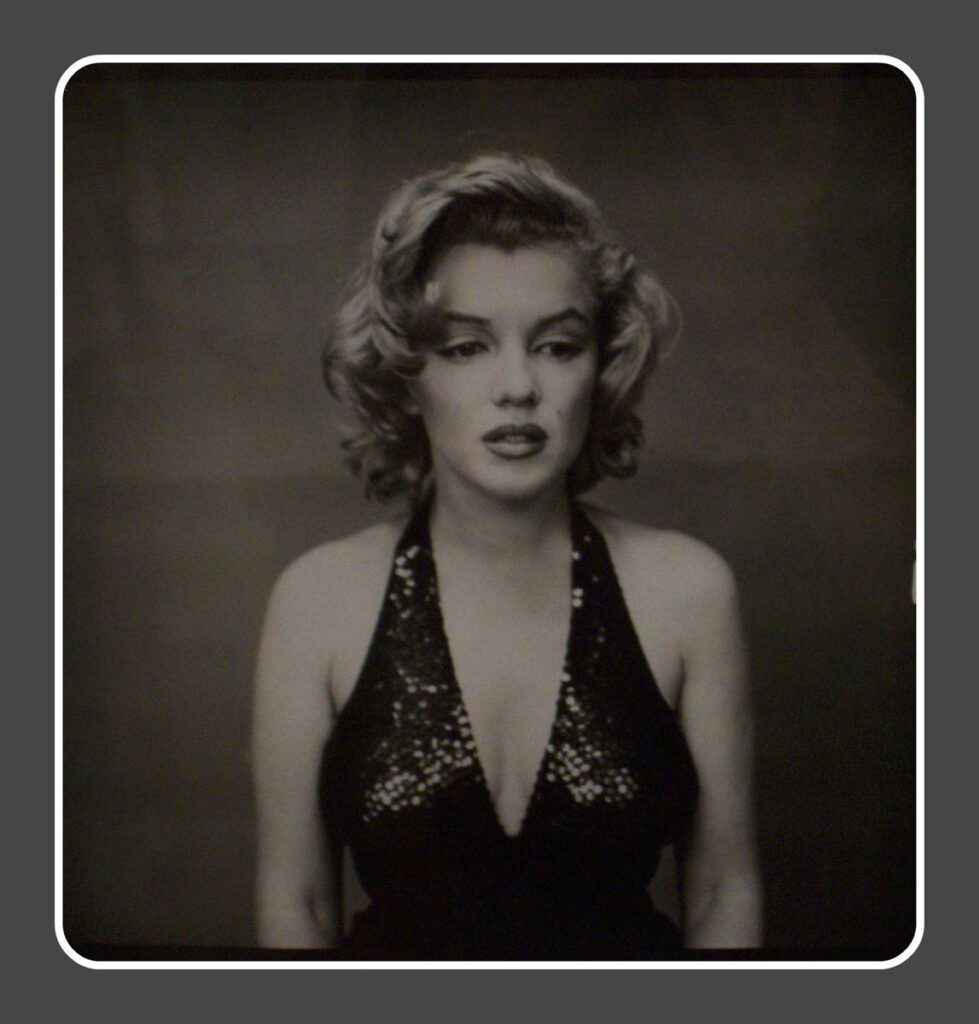
- Celebrity portraits
- Magazine covers
- Interviews
- Feature articles
- Creative storytelling
Editorial photography balances realism with artistic expression because it needs to communicate a real story, person, event, or idea while still having a strong visual style.
The photograph should remain truthful to the subject, but the photographer can use creative choices such as:
- Lighting to create mood and atmosphere
- Composition to guide the viewer’s attention
- Colour to establish an emotional tone
- Perspective and framing to add visual interest
- Timing to capture a meaningful moment
- Styling and location to strengthen the story
For example, in a magazine article about a fashion designer, an editorial photograph might show the designer working in their real studio rather than simply posing against a plain background. The photographer can use dramatic lighting, careful composition, and environmental details to make the image visually compelling while still representing the designer authentically.
So, realism provides the story, while artistic expression gives the story its visual character.
11. Maternity Photography
Studio maternity photography celebrates pregnancy through elegant, carefully lit portraits. Studios offer privacy and comfort while allowing photographers to create timeless images using controlled lighting and carefully selected backgrounds.
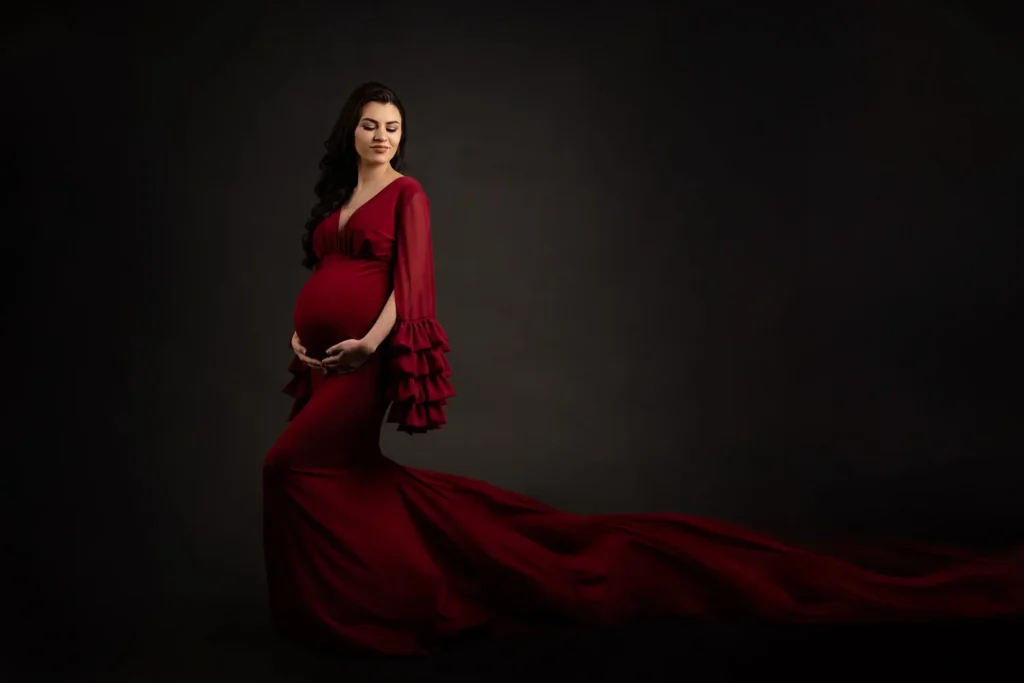
Popular lighting styles include:
- Soft side lighting
- Rim lighting
- Silhouettes
- High-key portraits
In maternity photography, flowing dresses, fabrics, and minimalist props are often used to enhance the image without taking attention away from the expecting mother.
- Flowing dresses create graceful shapes and emphasize the beauty of pregnancy.
- Soft fabrics can add movement, texture, and a sense of elegance.
- Minimalist props provide visual interest while keeping the composition clean and uncluttered.
The main purpose is to ensure that the mother remains the visual and emotional focus of the photograph. Instead of filling the frame with unnecessary objects, the photographer uses a few carefully chosen elements to support the mood, shape, and story of the image.
12. Newborn Photography
Newborn photography requires exceptional patience, safety awareness, and gentle handling.
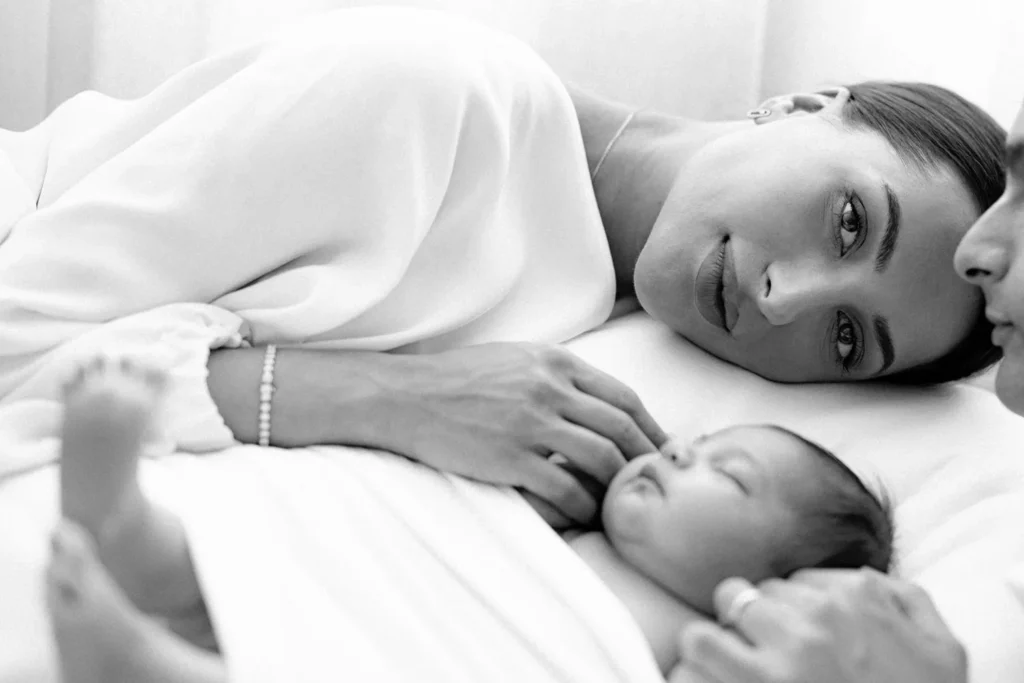
Studios provide:
- Comfortable temperatures
- Quiet environments
- Soft lighting
- Clean backgrounds
- Safe posing areas
Because babies are extremely sensitive, photographers prioritize safety above creativity. Many newborn photographers use continuous lighting or heavily diffused flash to create soft, soothing illumination.
13. Family Photography
Family portraits remain among the most requested studio services.
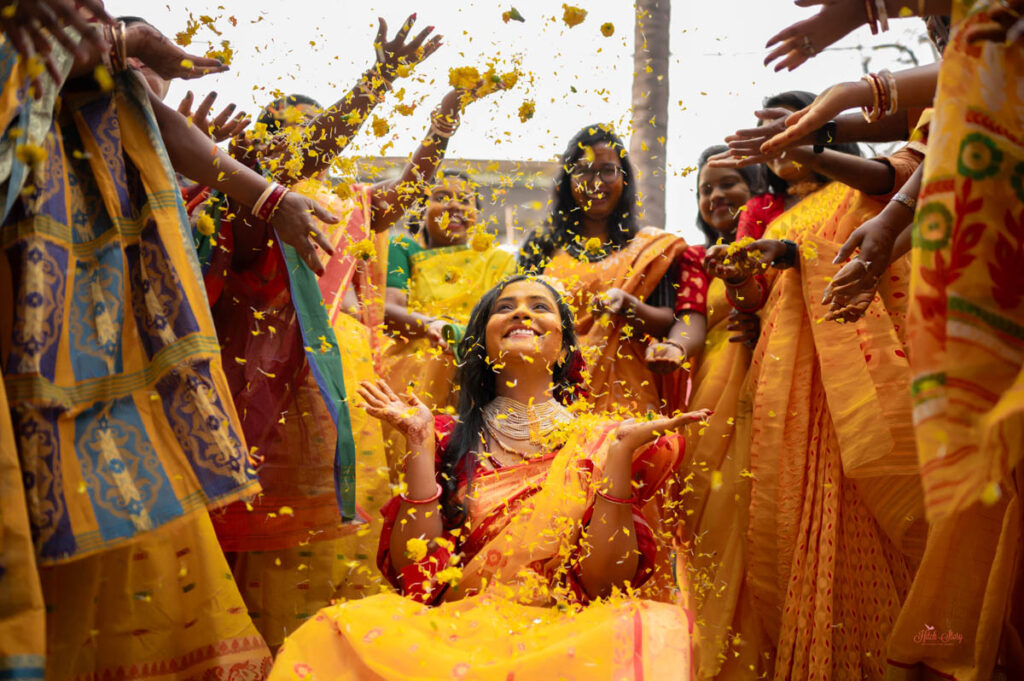
Studios simplify the process by providing:
- Consistent lighting
- Controlled backgrounds
- Comfortable seating
- Enough space for groups
Photographers focus on capturing natural interactions rather than rigid poses, encouraging conversation, laughter, and connection between family members.
14. Corporate Headshot Photography
Professional headshots have become increasingly important in today’s digital world.
Businesses use studio portraits for:
- Company websites
- LinkedIn profiles
- Press releases
- Business cards
- Marketing materials
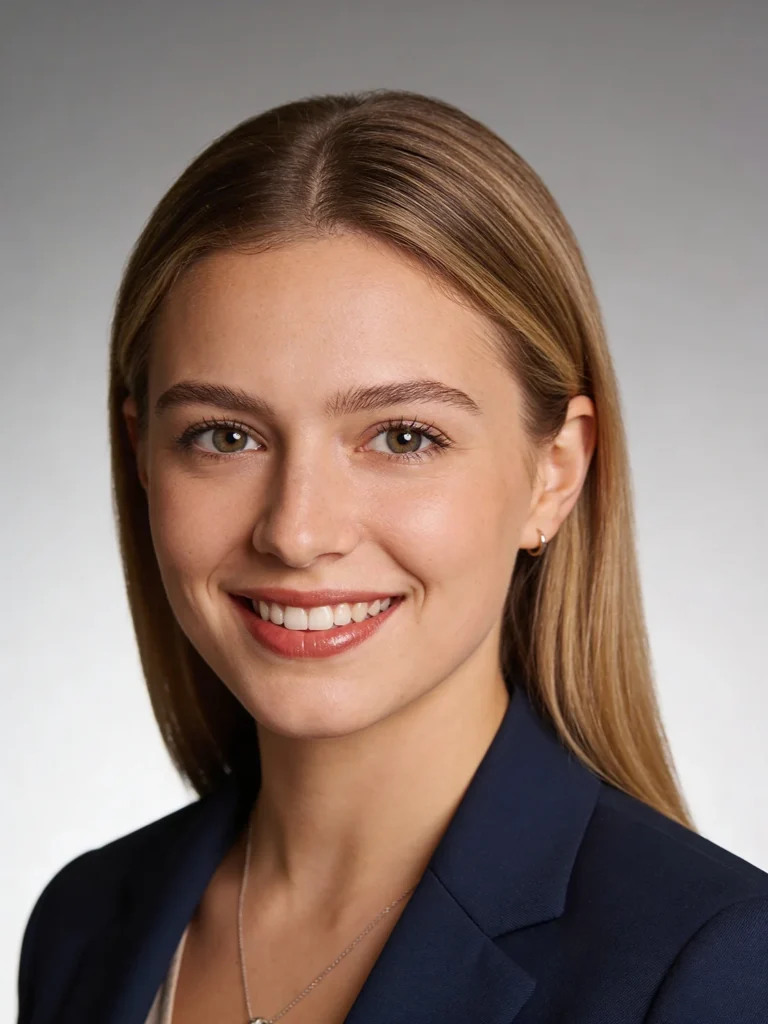
Consistency is critical when photographing entire teams. Matching lighting, backgrounds, and posing styles creates a unified and professional appearance across all employee portraits.
15. Fitness Photography
Fitness photography highlights strength, muscle definition, athletic performance, and determination. Studio lighting plays a major role in revealing body shape and muscle tone.
Common techniques include:
- Hard side lighting
- Rim lighting
- Low-key lighting
- High contrast
Athletes, trainers, fitness brands, and sports magazines frequently commission studio fitness photography.
16. Dance Photography
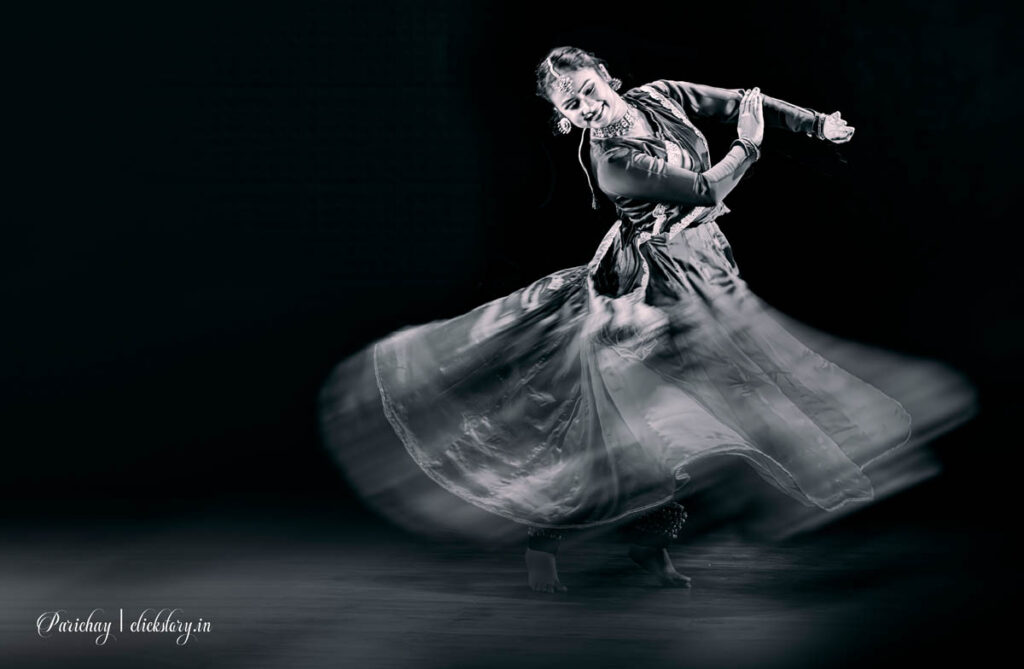
Dance photography combines portraiture with action.
Studios allow photographers to freeze movement using flash while controlling backgrounds and eliminating distractions.
Subjects include:
- Ballet
- Contemporary dance
- Classical dance
- Gymnastics
- Performing arts
Timing, posing, and lighting must work together to emphasize grace, energy, and motion.
17. Macro Studio Photography
Macro photography reveals details invisible to the naked eye.

Common subjects include:
- Insects
- Flowers
- Coins
- Watches
- Textures
- Scientific specimens
Because magnification exaggerates even the smallest movement, photographers often use:
- Focus stacking (click the button and find the details)
- Macro rails (click the button and find the details)
- Specialized lighting (click the button and find the details)
- Precision tripods (click the button and find the details)
Focus stacking in macro photography is a technique where the photographer takes several photographs of the same subject, each focused at a slightly different distance, and then combines them using software.
This is useful because macro photography often has an extremely shallow depth of field. At close distances, it can be difficult to keep the entire subject sharp in a single photograph.
For example, when photographing a small flower or insect, the photographer might take:
- One image focused on the front of the subject.
- Another focused slightly farther back.
- Additional images focused progressively toward the rear.
- Combine all the images in software to create one photograph with much greater depth of sharpness.
The result can show the entire subject sharply from front to back, while retaining the detailed appearance that macro photography is known for.
In simple terms: Focus stacking = multiple focus points + one final image with greater overall sharpness.
Macro rails are precision accessories used in macro photography to move the camera forward or backward in very small, controlled increments. They are especially useful for focus stacking. Instead of changing focus with the lens, the photographer keeps the focus fixed and gently moves the entire camera a tiny distance between shots.
For example: Shot 1 → move camera slightly → Shot 2 → move again → Shot 3 → move again → Shot 4
These photographs can then be combined through focus stacking to create a final image with greater depth of sharpness.
Why use a macro rail?
- Provides very precise camera movement
- Makes focus stacking more consistent
- Helps with extremely close subjects
- Allows precise composition adjustments
- Reduces accidental changes to focus or framing
A macro rail is particularly valuable for high-magnification macro photography, where even a movement of a fraction of a millimetre can significantly change the area in focus.
In simple terms, a macro rail is like a fine-adjustment track for your camera, allowing you to move it forward or backward with extreme precision.
Specialized lighting in macro photography refers to lighting equipment and techniques designed to illuminate very small subjects evenly and clearly, especially at high magnification.
Common options include:
- Macro ring lights: Surround the lens with light, providing relatively even illumination and reducing harsh shadows.
- Twin macro flashes: Two small flashes positioned on either side of the lens give greater control over direction, depth, and shadows.
- Small LED lights: Useful for continuous lighting and for seeing exactly how light falls on the subject.
- Diffusers and reflectors: Soften harsh light and help control highlights and shadows.
- Off-camera flash: Allows the photographer to create more dramatic and three-dimensional lighting.
Specialized lighting is particularly useful because macro subjects are often photographed very close to the lens, where the camera or lens itself can block available light.
The goal is not simply to make the subject brighter, but to reveal fine details, maintain natural colours, control shadows, and create depth without producing distracting highlights.
Precision tripods in macro photography are sturdy tripods designed to provide maximum stability and precise camera positioning when photographing very small subjects.
Macro photography often involves high magnification, where even a tiny camera movement can cause blur or change the composition. A stable tripod helps prevent this.
Why precision tripods are useful
- Reduce camera shake, especially during slow shutter speeds.
- Maintain exact framing when making multiple exposures.
- Allow precise positioning of the camera close to the subject.
- Support focus stacking, where consistent framing is important.
- Improve composition, allowing the photographer to make very small adjustments.
A tripod with a three-way or geared head can be particularly useful because it allows controlled adjustments in different directions.
In simple terms, a precision tripod gives the macro photographer a stable foundation and fine control over camera position, which becomes increasingly important as magnification increases.
Studio environments make these techniques much easier to control.
18. Tabletop Photography
Tabletop photography specializes in photographing small objects on controlled sets.
Popular subjects include:
- Cosmetics
- Stationery
- Handmade crafts
- Food
- Toys
- Electronics
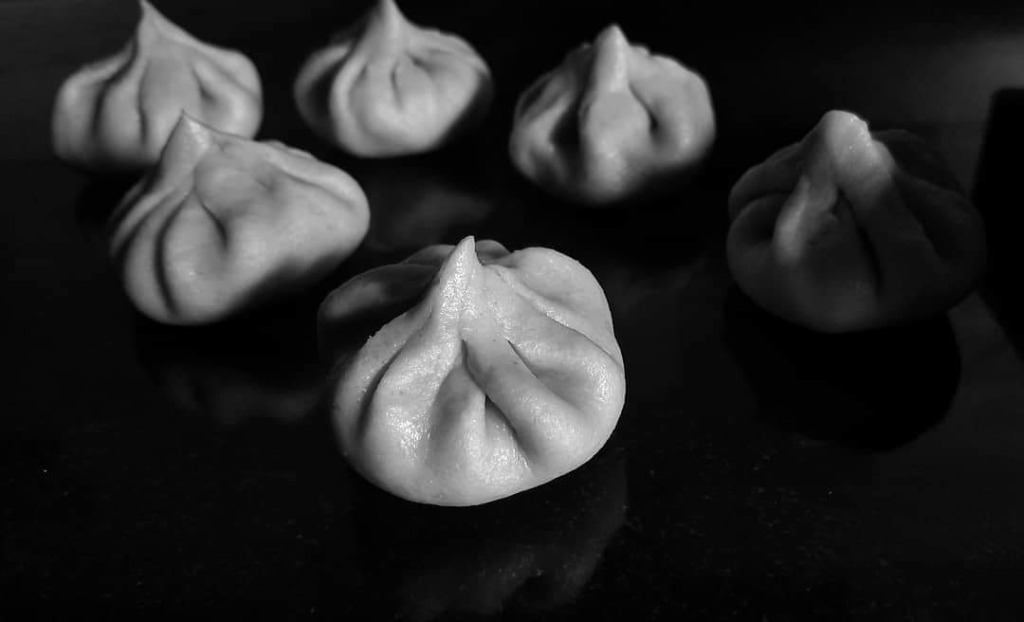
Photographers carefully arrange props, backgrounds, reflections, and lighting to create visually appealing commercial images. Despite its modest scale, tabletop photography requires exceptional attention to composition and detail.
Conclusion
Studio photography offers remarkable creative flexibility, allowing photographers to work across portraits, fashion, products, food, advertising, fine art, and many other genres within a controlled environment. Each genre requires a different approach to lighting, composition, equipment, and subject handling, but they all share the same foundation: careful control of light and creative intent. Understanding these 18 major genres helps photographers choose the right techniques, develop their own visual style, and make better use of the studio as a creative space. Ultimately, a studio is more than just a place to take photographs—it is a controlled environment where ideas can be shaped, refined, and transformed into compelling visual stories.
New to this genre? Then read about the various types of studio, benefits and so on. What Is Studio Photography? Types, Benefits & Beginner Guide. Then forward your knowledge with the advantages of studio photography.
