

One of my colleague is very much fond of foods. One day he ate so much in lunch time that he missed the next class. He is the Asst. Professor of an engineering college in Kolkata, India. Next day he promised to take light food and after the lunch session he ate 4 times between 2 to 5 pm. Three factors are uncontrollable to him; a) the mouth width (wants to put all food at a time), b) the duration of the lunch time and c) the quantity of food he consumed. When he came to me for consultancy about the right food, right time and right quantity, I tell him the story of exposure in photography.
Today I am discussing about the exposure. This is very much important factor in photography. It means how much light stores into the sensor to display a perfect picture to the user. More light means over exposure and less light means under exposure. Both are not desirable for maximum situation in photography. Balanced one gives a picture real life. It depends upon various factors.
In photography 3 key factors are responsible for it.
a) Aperture:
It controls how much light enters the camera by adjusting the size of the opening in the lens, much like how the width of a colleague’s mouth determines how much food enter.
It is expressed using f-numbers, such as:
- f/1.4
- f/2
- f/2.8
- f/4
- f/5.6
- f/8
- f/11
- f/16
A smaller f-number represents a larger physical opening. For example:
f/2.8 → large opening → more light
f/11 → small opening → less light
Aperture also controls depth of field
This is one of the most important relationships to understand.
A wide aperture such as f/1.8 can produce a shallow depth of field, helping separate a subject from the background.
A narrow aperture such as f/11 produces greater depth of field, which is often useful for landscapes and architecture.
So changing aperture affects both:
Exposure + depth of field
That is why aperture is a creative control, not merely a brightness control.
b) Shutter speed:
It controls the duration of the exposure (colleague’s lunch duration)
Shutter speed determines how long the camera’s shutter remains open or, in an electronic-shutter implementation, how long the sensor is read/exposed for the capture.
Common shutter speeds include:
- 1/1000 sec
- 1/500 sec
- 1/250 sec
- 1/125 sec
- 1/60 sec
- 1/30 sec
- 1 sec
- 10 sec
- 30 sec
A faster shutter speed allows less light to reach the sensor. A slower shutter speed allows more light. For example:
1/1000 sec → very little light
1/30 sec → much more light
Shutter speed also controls motion
This is where shutter speed becomes particularly important. A fast shutter speed can freeze movement.
For example:
- 1/1000 sec → sports
- 1/500 sec → fast action
- 1/250 sec → many moving subjects
- 1/125 sec → general handheld photography
- 1/30 sec → movement may become visible
- Several seconds → intentional motion blur
Therefore:
Faster shutter → less light + less motion blur
Slower shutter → more light + more motion blur
c) ISO speed:
It controls the sensitivity of camera’s sensor to a given amount of light (Quantity of food he consumed).
Common ISO settings include:
- ISO 100
- ISO 200
- ISO 400
- ISO 800
- ISO 1600
- ISO 3200
- ISO 6400
- ISO 12800
In digital cameras, increasing ISO generally makes it possible to produce a brighter image from the available captured signal.
But higher ISO can also make image noise more visible. For example:
ISO 100 → usually cleaner image
ISO 3200 → useful in low light, but potentially more visible noise
ISO should therefore not be viewed simply as a “brightness button.” It is a tool that helps you balance shutter speed and aperture when available light is limited.
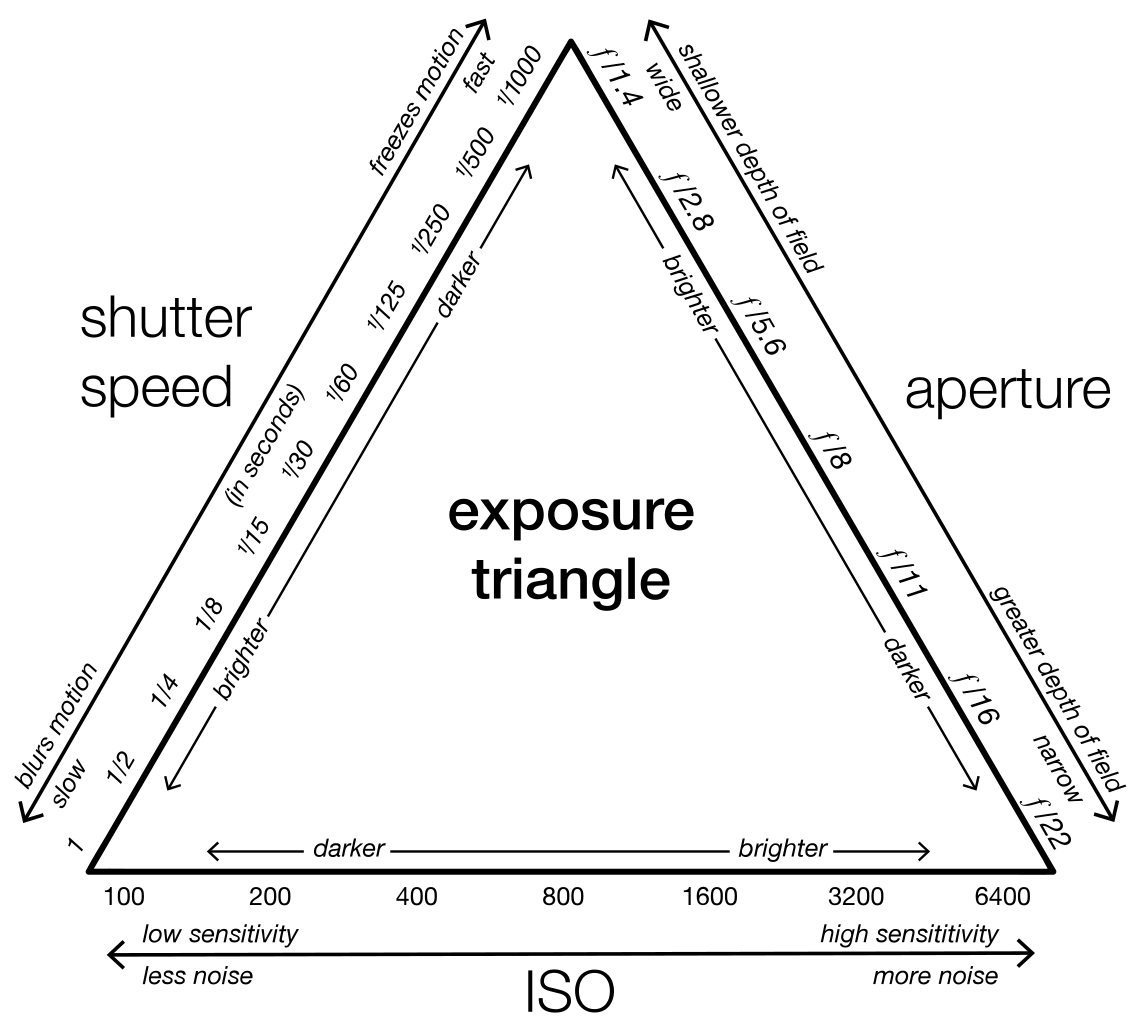
Now-a-days we can find in digital cameras mostly DSLRs and mirrorless have some priority buttons to control the exposure automatically to give the user a better picture framed against an object. These are as follows:
1. Auto mode: camera automatically selects the aperture, shutter speed and ISO
2. Program mode: Camera selects the aperture and shutter speed, but user can customize the ISO and exposure compensation.
3. Shutter priority: Camera selects the aperture where the user can select the shutter speed and ISO speed.
4. Aperture priority: Camera selects the shutter speed where the user can select the aperture speed and ISO speed.
5. Manual mode: this is an expert mode because the three factors like aperture, shutter speed and ISO speed are customizing by the user as per his/her choice manually.
6.Bulb: Shutter speed is controlled by the user by pressing the shutter release button. It is mainly used for inviting light into the sensor for more than equal to 30 seconds.
How the Three Settings Work Together
The most important concept in exposure is that aperture, shutter speed, and ISO are interconnected.
Suppose your photograph is correctly exposed at:
- f/4
- 1/250 sec
- ISO 100
If you change the aperture to f/2.8, you are allowing more light into the camera. To maintain approximately the same exposure, you could compensate by using a faster shutter speed.
For example:
f/4 → f/2.8
allows more light.
You might therefore change:
1/250 sec → 1/500 sec
This keeps the overall exposure approximately similar while changing the visual characteristics of the photograph. The result is not identical, however. The aperture has changed, so the depth of field changes too.
This is the key idea:
Different combinations of aperture, shutter speed, and ISO can produce similar overall exposure while creating very different-looking photographs.
Understanding Stops of Exposure
Photographers often describe changes in exposure using the term stop. A change of one stop represents approximately a doubling or halving of the amount of light. For example, with shutter speed:
1/125 → 1/250
reduces the exposure by one stop because the sensor is exposed for roughly half as long.
Going in the opposite direction:
1/125 → 1/60
approximately doubles the exposure time.
Similarly, aperture changes can represent one-stop changes, although modern cameras often allow smaller fractional increments.
ISO also commonly changes in one-stop increments:
ISO 100 → 200 → 400 → 800 → 1600
Each step approximately doubles the amplification level.
Understanding stops makes it much easier to predict what will happen when you change camera settings.
So, the exposure is a triangle of Aperture, Shutter speed and ISO speed. It is the controlling factor for right light and darkness for a certain picture.
Happy clicking, happy sharing.
You may like to read Exposure Compensation article.
Frequently Asked Questions (FAQs)
1. What is exposure in photography?
Exposure in photography refers to how much light reaches the camera sensor to create an image. Proper exposure ensures the photo looks natural and close to real life.
2. Why is exposure important in photography?
Exposure is important because it controls image brightness and detail. Incorrect exposure can result in loss of highlights or shadows, making the photo look unrealistic.
3. What happens when a photo is overexposed?
Overexposure occurs when too much light hits the sensor, causing bright areas to lose detail and appear washed out.
4. What happens when a photo is underexposed?
Underexposure happens when too little light reaches the sensor, making the image too dark and hiding important details.
5. Is overexposure or underexposure desirable in photography?
In most situations, neither overexposure nor underexposure is desirable. A balanced exposure usually produces the most natural and visually pleasing result.
6. What is a balanced exposure in photography?
Balanced exposure means the right amount of light is captured, preserving details in both highlights and shadows for a realistic image.
7. How does exposure affect real-life appearance in photos?
Proper exposure helps a photograph reflect real-life lighting conditions, making the image look natural to the viewer.
8. What factors affect exposure in photography?
Exposure depends on multiple factors such as lighting conditions, camera settings, and the scene being photographed.
9. Can exposure be adjusted for different photography situations?
Yes. Exposure must be adjusted based on the environment, subject, and available light to achieve the best results.
10. Why do beginners struggle with exposure in photography?
Beginners often struggle with exposure because understanding light balance takes practice and awareness of how different lighting conditions affect the sensor.

lovely