

Photography business basics are often forgotten, even though they are just as important as learning how to use a camera. Many people see photography only as an art and focus on cameras, lenses, lighting, and editing. But photography is also a business. Many talented photographers fail, not because they are bad at taking photos, but because they don’t pay attention to things like pricing, contracts, copyright, or dealing with clients. Without these basics, it is very hard to build a successful career in photography.
Pricing, contracts, licensing, copyright law, and negotiation are not optional—they are the foundation of a sustainable career. Let’s go step by step and understand why these areas matter and how you can apply them in your photography journey.

1. Pricing Your Photography Services
Many new photographers struggle with pricing. They either charge too little because they feel under confident, or they copy someone else’s rates without calculating their own costs. This often leads to burnout and financial loss.
Think about it like this:
- If you spend ₹1,50,000 on a camera and lenses, ₹20,000 yearly on software, and countless hours learning editing, your price should reflect that investment.
- A one-hour photoshoot is never just one hour—it includes travel, setup, editing, client communication, and delivery.
Example:
If you charge ₹5,000 for a two-hour shoot but spend another 8–10 hours editing, you’re working almost a full day for very little money. Over time, this makes photography unsustainable.
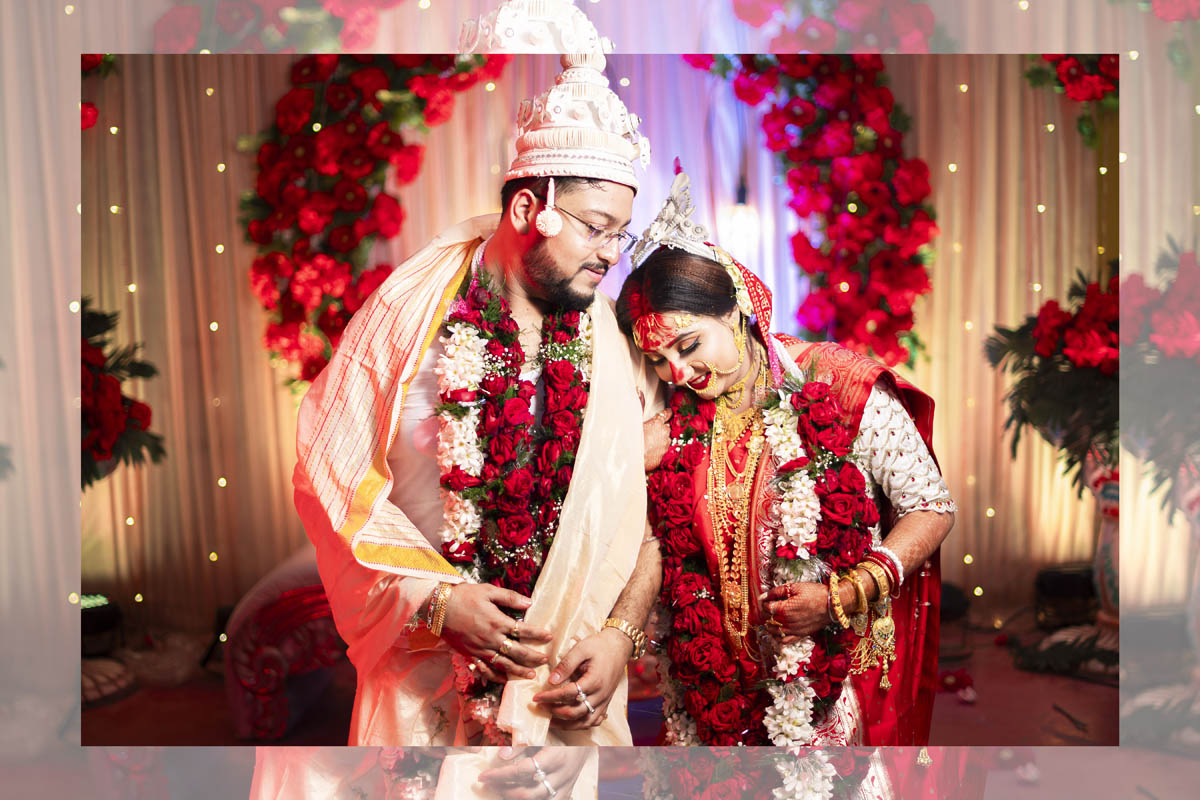
Tips for better pricing:
- Calculate your cost of doing business (gear, rent, software, taxes).
- Add your profit margin (you are running a business, not a charity).
- Offer tiered packages (basic, standard and premium) to appeal to different clients.
- Be transparent about what’s included—like number of edited photos, delivery time, and extra charges.
Case Study – Wedding Photography Pricing
Arjun, a wedding photographer in Kolkata, started by charging ₹20,000 per wedding. He thought this was competitive, but after travel, assistant fees, editing hours, and printing albums, his profit was almost zero.
After consulting a mentor, he calculated his cost of doing business:
- Gear maintenance: ₹5,000 per wedding (depreciation).
- Travel: ₹2,000.
- Editing time: 30 hours.
- Album printing: ₹8,000.
He realized ₹20,000 was unsustainable. He restructured his packages into three tiers—Basic (₹35,000), Standard (₹55,000), Premium (₹85,000). Surprisingly, most couples chose the Standard package because it felt like good value. His income doubled, and he finally had profit left after expenses.
Lesson: Proper pricing not only covers costs but also shows clients your value.
2. The Power of Contracts
A handshake or verbal promise is never enough in photography. Contracts protect both you and your clients by setting clear expectations.
What contracts should cover:
- Scope of work (what type of shoot, how many images, editing style).
- Payment terms (deposit, balance, due dates).
- Delivery timeline (how long editing will take).
- Cancellation or rescheduling policy.
- Rights of usage (who owns the photos and how they can be used).
Example:
You book a wedding shoot and block an entire day. If the client cancels a week before, you lose that slot. Without a contract, you cannot recover your time. But if your contract includes a non-refundable booking fee, you are financially protected.
Tip: Use contract templates from reliable photography associations, but adapt them to your business. For big projects, consult a lawyer for customization.
Case Study – Family Photoshoot Cancellation
Priya, a portrait photographer, booked a family photoshoot for ₹12,000. The client cancelled one day before due to personal reasons and asked for a full refund. Priya had blocked her entire weekend and lost the chance to take another booking.
At that time, she didn’t have a contract, so she refunded the money and suffered the loss. Later, she introduced a non-refundable booking fee (30%) in her contracts. Six months later, another client cancelled, but Priya was able to keep the booking fee, protecting her time and income.
Lesson: A contract ensures your work and time are respected.
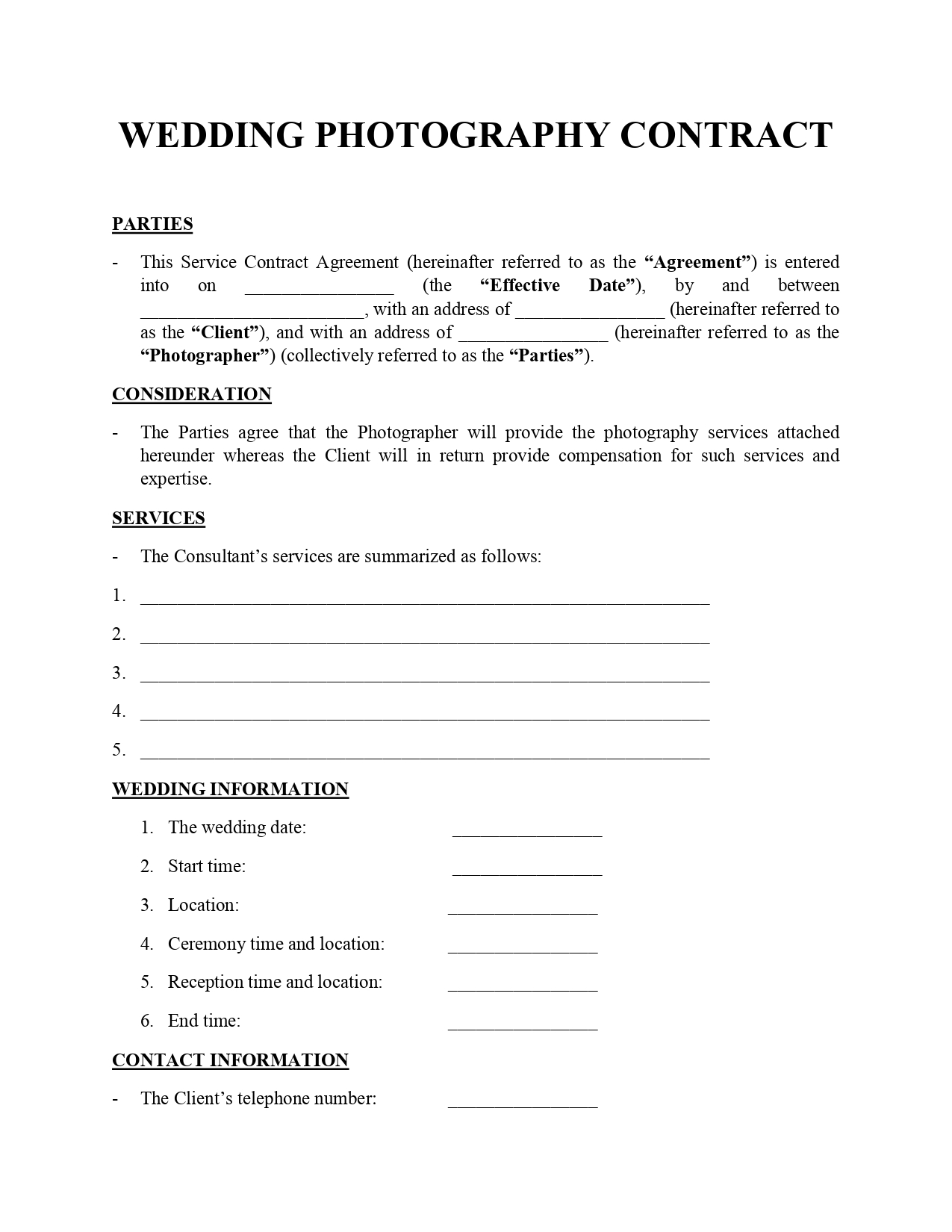
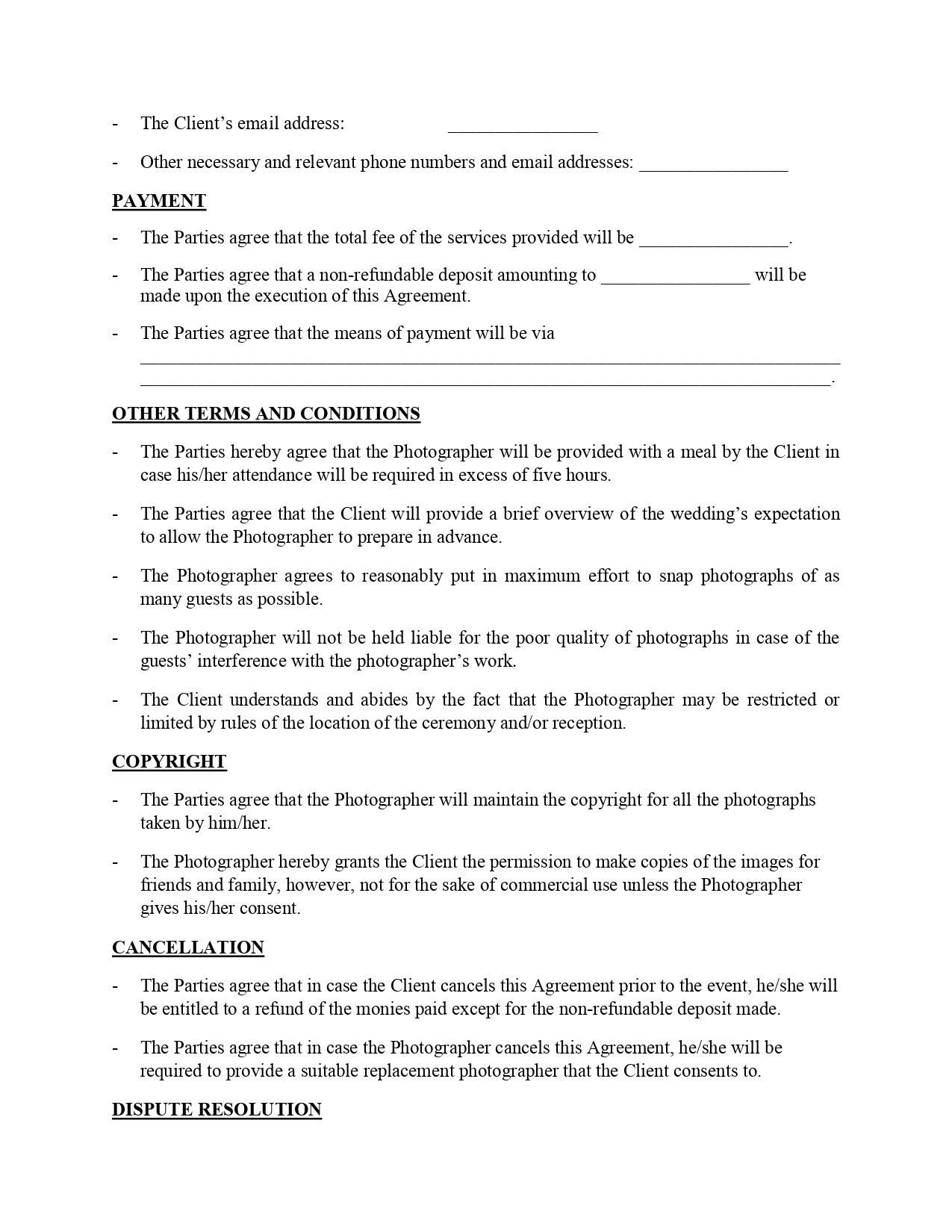
A template of a contract form:

3. Licensing Your Photos
Licensing means giving someone permission to use your photos in specific ways. It’s common in commercial and corporate photography. Unlike personal shoots, where the client usually just wants photos for personal use, businesses want to use them for profit.
Example:
You take product photos for a clothing brand. They want to use the images on Instagram (social media license). Later, they also want to use them on a hoarding or billboard (advertising license). That requires additional payment, because the usage is wider and the impact is larger.
Types of licensing:
- Personal use: For individuals (family portraits, weddings).
- Commercial use: For businesses (ads, websites, product launches).
- Editorial use: For magazines, newspapers, blogs.
- Exclusive rights: Only one client can use the photo, and you cannot resell it.
- Non-exclusive rights: You can license the same image to multiple clients.
Tip: Always write down the licensing terms—who can use the photo, where, and for how long. This prevents misunderstandings later.
Case Study – Product Photography Licensing
Ravi, a product photographer in Mumbai, shot a catalog for a small clothing brand. He charged ₹25,000 for the shoot, and the client used the photos on Instagram.
Months later, Ravi saw his photos on large billboards across the city. The brand had used the same images in a much bigger campaign without paying him extra. Unfortunately, since Ravi had not defined licensing terms in his agreement, he had no legal ground to charge more.
After this incident, Ravi started adding usage rights in his contracts—for example, social media use only, or one-time print use. If a client wanted wider rights (like billboards), they had to pay a licensing fee.
Lesson: Licensing ensures fair payment when clients use your work commercially.
4. Understanding Copyright Law
Copyright is one of the most misunderstood areas in photography. Many clients assume they “own” the photos after paying, but that’s not true. Legally, the photographer owns the copyright as soon as the image is created.
Example:
If you shoot a model’s portrait and post it online, you still hold the copyright. If someone else downloads it and uses it for an ad campaign without your permission, it’s copyright infringement. You can ask them to remove it or even demand payment for damages.
Key facts about copyright:
- Copyright is automatic—you don’t have to apply for it.
- You can transfer copyright, but only in writing.
- Clients usually pay for usage rights, not full ownership.
- Registering your work with copyright authorities gives stronger legal protection.
Tip: Add watermarks, use metadata, and keep raw files safe as proof of ownership. For commercial projects, specify in the contract who owns what.
Case Study – Online Copyright Infringement
Meera, a wildlife photographer, posted her tiger photos on Instagram. A travel company downloaded her pictures and used them on their website and brochures without permission.
Meera contacted them and demanded removal. At first, they ignored her, but since she had kept her RAW files as proof of authorship, she could legally establish ownership. After sending a formal copyright notice, the company not only removed the images but also paid her compensation.
Lesson: Keep proofs of your work (RAW files, metadata). Protecting copyright strengthens your business.
5. Negotiation Skills for Photographers
Negotiation is not about fighting with clients—it’s about communicating value. Many photographers lose money because they agree to every demand. Learning how to say “yes, but at the right price” is crucial.
Example:
Client: “We have a budget of ₹10,000 for 100 edited photos.”
You: “For ₹10,000, I can deliver 40 edited photos. If you’d like more, we can create a package for ₹15,000.”
This way, you’re not rejecting the client but showing them clear options.

Tips for negotiation:
- Stay polite and professional.
- Never undervalue yourself—clients respect confident pricing.
- Offer options instead of flat rejection.
- Put all agreements in writing to avoid disputes later.
Case Study – Event Photography Negotiation
Karan, an event photographer, quoted ₹40,000 for a corporate event. The client said their budget was only ₹25,000. Instead of rejecting or accepting immediately, Karan negotiated:
He offered two options:
- ₹25,000 package with 200 edited photos.
- ₹40,000 package with 400 edited photos plus a highlight video.
The client chose the ₹40,000 package because they saw more value in it. Karan didn’t reduce his price but gave choices that matched the client’s needs.
Lesson: Negotiation is about flexibility without undervaluing yourself.
6. Photography Business Checklist
- Calculate fair prices based on time, cost, and skill.
- Always use written contracts for every project.
- Define licensing terms clearly for business clients.
- Protect your copyright with watermarks and registrations.
- Learn negotiation—offer solutions, not discounts.
7. Common Business Mistakes Photographers Make
Even skilled photographers lose clients, money, or reputation because of avoidable business mistakes. Here are the most common ones:
A. Shooting Without Contracts
Many beginners trust verbal agreements. But when disputes arise (late payments, cancellations, or extra demands), you have no legal proof.
Fix: Always have a written contract, even for small jobs.
B. Underpricing Out of Fear
New photographers often charge very little to attract clients. This sets unrealistic expectations and damages the industry.
Fix: Price based on your costs, time, and value—not fear of rejection.
C. Ignoring Licensing and Usage Rights
Some photographers hand over all photos without discussing where and how they can be used. Businesses may then use your work on billboards, ads, or merchandise without extra pay.
Fix: Clearly state licensing terms in writing.
D. Not Understanding Copyright
Many photographers don’t realize that they own copyright by default. Some even give it away unknowingly.
Fix: Learn your rights. Unless specifically sold, you always own the photos you create.
E. No Advance Payment or Booking Fee
Without a deposit, clients may cancel at the last minute, leaving you with lost income.
Fix: Collect 20–50% booking fee upfront (non-refundable).
F. Unlimited Free Revisions
Some photographers edit endlessly because clients keep asking for changes. This eats into your time and profits.
Fix: Set clear limits (e.g., 2 rounds of revisions included, extra revisions at ₹X per round).
G. Neglecting Taxes and Invoices
Ignoring business finances may cause trouble during tax season and affect credibility with clients.
Fix: Issue proper invoices, keep records, and consult a tax professional.
H. Poor Communication with Clients
Some photographers don’t update clients about timelines or fail to explain packages clearly. This creates mistrust.
Fix: Be transparent about delivery time, what’s included, and what’s extra.
I. Giving Away Raw Files
Many beginners give clients RAW files without realizing they’re giving away full creative control.
Fix: Deliver only edited, final images unless RAW delivery is specifically charged at a premium.
Lesson: Avoiding these mistakes saves you stress, time, and money—and builds your reputation as a professional.
Conclusion
Photography is not just about creating beautiful images—it’s also about running a sustainable business. Without proper pricing, contracts, licensing, copyright knowledge, and negotiation skills, even the most skilled photographer can struggle.
By treating your photography like a business, you not only protect yourself but also earn the respect of clients who see you as a professional.


Really helpful information and the template. Thank you.